April 24. The road to Tsitsernakaberd
A practical companion for a visit to the Armenian Genocide Memorial on Remembrance Day: route, flowers, the rhythm of the day, and the etiquette of remembrance.
A practical companion for those walking up to Tsitsernakaberd on April 24 with care and understanding — the route, the tradition of flowers, how the day is built, and how to behave at the eternal flame.
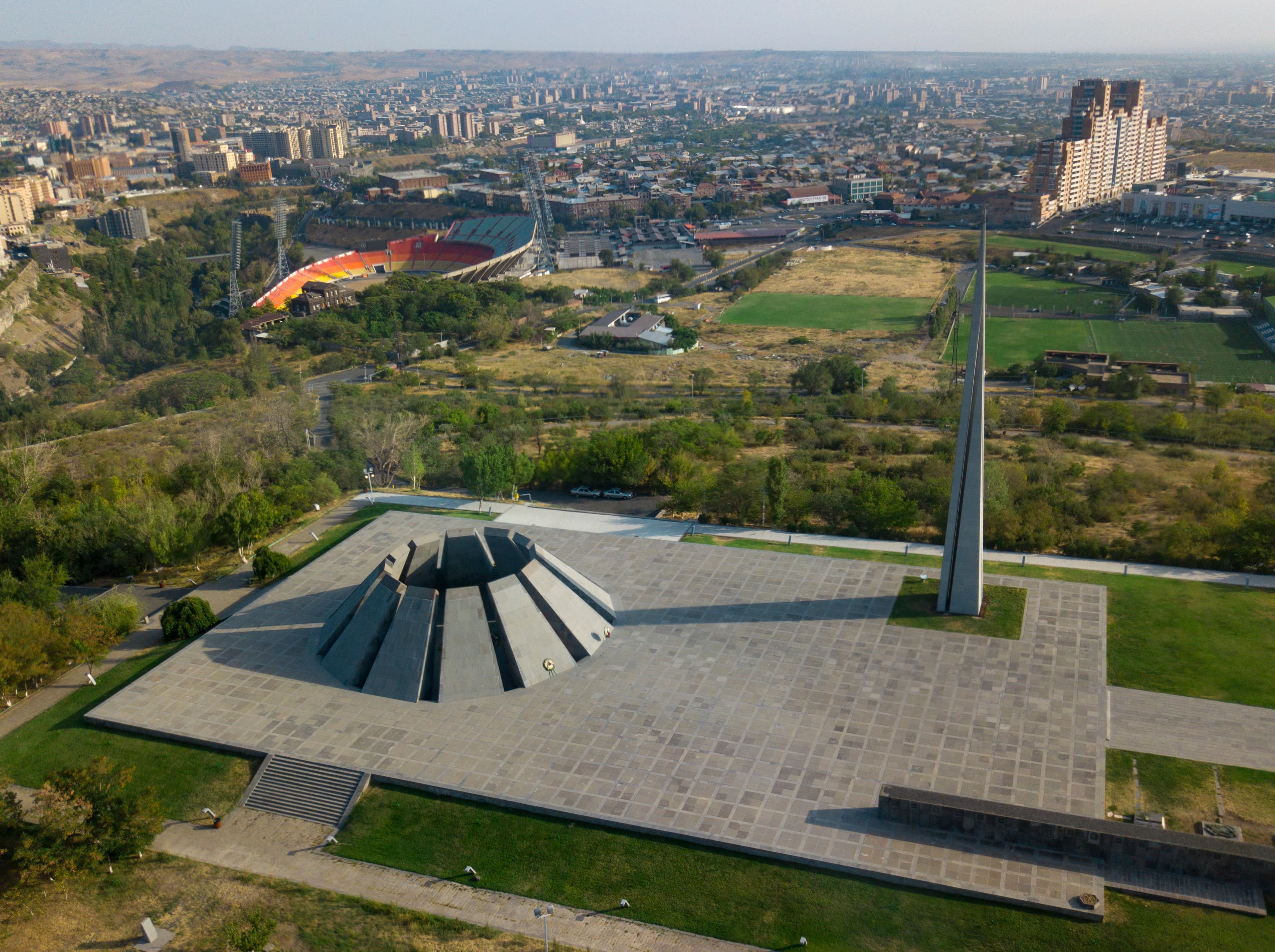
The memorial complex on the Tsitsernakaberd hill was opened on 29 November 1967. Its architects, per the Armenian Genocide Museum-Institute, were Arthur Tarkhanyan and Sashur Kalashyan. The complex has three core structures: the «Reborn Armenia» stele symbolizing rebirth; the Temple of Eternity, a sunken circular chamber where twelve inwardly canted khachkar-like stones lean over the eternal flame — the museum says they «symbolize mourning in memory of the victims», and many visitors also read the twelve as the lost provinces of Western Armenia; and a 100-metre basalt Memorial Wall engraved with the names of the massacre sites in the Ottoman Empire. The Armenian Genocide Museum-Institute opened next to the memorial on 29 September 1995 (80th anniversary); between 2011 and 2015, for the centenary, the complex was renovated and the museum's exhibition was expanded roughly two-and-a-half-fold (to 2,400 m², 12 halls).
- 24 April 1915
On the night of 24 April 1915, Ottoman authorities began arresting Armenian intellectuals, clergy, and community leaders in Constantinople. The Armenian Genocide Museum-Institute records approximately 800 people arrested on 24 April and the days immediately following; historians place the first wave of that night at around 235–270. Most were later killed. This date is the universally observed anchor of Armenian Genocide remembrance.
- 664 000 – 1.5 million
Mainstream academic estimates of Armenians killed in the Ottoman Empire between 1915 and 1923. The US Holocaust Memorial Museum writes: «at least 664,000 and possibly as many as 1.2 million». The Armenian Genocide Museum-Institute and the European Parliament's 2015 centenary resolution both use the figure of approximately 1.5 million. The genocide has been affirmed unanimously by the International Association of Genocide Scholars (1997) and recognized by more than 30 state parliaments.
Remembrance is not only the memorial on the hill. The city below is itself a record of what happened. Three facts, with sources.
- ×2
Yerevan's population roughly doubled in the decade after 1915
- 1925
The architect of modern Yerevan personally drew its first refugee quarter
- 7+
Districts carrying the names of cities destroyed in the Genocide
- Nor Arabkir — Arabkir · today Arapgir, Turkey
- Nor Malatia — Malatia · today Malatya, Turkey
- Nor Sebastia — Sebastia · today Sivas, Turkey
- Nor Kilikia — Cilicia · historical region in today's southeastern Turkey
- Nor Zeytun — Zeytun · today Süleymanlı, Turkey
- Nor Butania — Bithynia · historical region in today's north-western Turkey
On the eve of the Genocide Yerevan was a small provincial town of roughly 30,000. By the 1926 Soviet census it counted about 65,000 — a shift driven in large part by survivors who fled Western Armenia through the Caucasus.
Britannica — YerevanAlexander Tamanyan's 1924 master plan designed Yerevan — the concentric ring, the boulevards, the Opera House — for about 150,000 people. At the 1926 Soviet census the capital held barely 65,000. A year after the master plan, in 1925, Tamanyan drew up the general plan for Nor Arabkir: a new settlement laid out for survivors of the Genocide from the Western Armenian town of Arabkir (Ottoman Arapgir). Waves of survivors from Van, Mush, Bitlis and other destroyed cities swelled Yerevan through the late 1910s and 1920s, and their descendants shaped the city in the decades that followed.
EVN Report — How Genocide Survivors Made Yerevan GreatNor Arabkir (1925), Nor Malatia (1925), Nor Sebastia (1927), Nor Kilikia, Nor Zeytun, Nor Butania (1925) — the prefix Nor (New) marks Yerevan neighborhoods populated by Armenian Genocide survivors and named after the towns or regions they had been driven out of. Beyond the city limits, the villages of Nor Kharberd (1929, Masis, Ararat Province) and Nor Ayntab carry the same pattern. Walking through today's Yerevan, you are also walking through a map of what was lost.
Key points on the way to the memorial. On April 24 the streets around the memorial park are closed to vehicles; the last stretch is always on foot.
Legend
- Memorial complex
- Nearest metro
- Pedestrian approach
- Common starting point
- Outside the city centre (airport, etc.)
Walking routes from common starting points
Coming from somewhere specific? Tap a starting point to add its walking route to the map.
The bold indigo line traces the path the crowd typically follows on April 24, marked Start to End: arrive from the western approach near Hamalir, walk through the memorial complex past the eternal flame, and continue south down Tsitsernakaberd Avenue.
Tap the location button on the map to draw a route from where you are. Shown only if you are within walking distance.
Approximate paths suggested by OpenStreetMap's pedestrian router. On April 24 many streets are closed and people follow the flow of the crowd; actual routes may differ in minor detail.
Open in a map app
For turn-by-turn directions from your own location.
Streets and landmarks mentioned on this page
If you don't know Yerevan, each name below opens on a map.
- Kirk Kerkorian Street (formerly Leningradyan Street)Main north–south artery on the west side of the Hrazdan gorge, running through Ajapnyak and Malatia-Sebastia districts. The Yerevan City Council renamed Leningradyan Street after the Armenian-American philanthropist Kirk Kerkorian on 23 October 2025; many maps and local signs still show the old name.
- Tsitsernakaberd HighwayThe road wrapping around the memorial hill from the south and west. The staircase to the memorial plateau rises from this road; on April 24 the road is closed and the last stretch is walked.
- Kievyan BridgeMain crossing over the Hrazdan gorge between the city centre and Ajapnyak. Those walking from Republic Square via Mashtots Avenue cross the gorge here.
- Kievyan StreetStreet at the foot of the memorial hill; one of the two main flower-vendor rows on April 24.
- Proshyan StreetAdjacent to Kievyan; the other main flower-vendor row.
- Mashtots AvenueMain north–south avenue of central Yerevan; the traditional walking route from Republic Square to Kievyan Bridge.
- Hrazdan GorgeThe river gorge that separates Kentron from the memorial hill; the walking route crosses it via Kievyan Bridge.
On April 24 the memorial is accessible only on foot for the last stretch. Traffic around Tsitsernakaberd Avenue and the memorial park is restricted; arrive prepared to walk. The route is ascending but paved and manageable for most visitors.
By metro
Barekamutyun is the closest station, on the east side of the Hrazdan gorge. The walk from the station to the flame is longer than it looks — about 5 km and 60–75 minutes: downhill through Arabkir along Kievyan Street, across the Kievyan Bridge over the gorge, and up through the memorial park. Faster: take a bus down to the «Hamalir» stop, which is within a short walk of the park.
On foot from Republic Square
Two common routes: the shortest via Argishti Street and Victory Bridge (about 3.2 km, 40–50 minutes), or the traditional route via Mashtots Avenue and Kievyan Bridge (about 4.5 km, 55–65 minutes) — the path the torchlit march and most locals take. On April 24, thousands walk this — you will not be alone.
By car
Tsitsernakaberd Avenue is closed to private traffic on April 24. The practical drop-off / parking point is around Hrazdan Stadium — there is no formally designated lot, but in past years drivers leave cars on side streets nearby (or near Barekamutyun and Zoravar Andranik metros) and continue on foot or by free city shuttle. Ride-hail apps (Yandex, GG) may drop you at the Hamalir park entrance but cannot reach the memorial itself.
By intercity bus from a marz
Yerevan has three intercity bus stations and none of them sits near Tsitsernakaberd. Kilikia (the south and international hub: Goris, Sisian, Tbilisi) is the closest — Hrazdan Stadium is roughly 1 km on foot from there. Northern Bus Station (Sevan, Dilijan, Vanadzor) and Sasuntsi Davit (Ararat valley) are further; from either, take the metro to Barekamutyun or Zoravar Andranik. On April 24 the city runs free shuttles dedicated to memorial visitors, 08:30–22:00, looping between Hrazdan Stadium and the two metro stations — board at any of those three points.
For long-distance drives that don't fit on the city map above, here are the practical handoffs to a full-featured map app. The destination is Hrazdan Stadium — the April 24 drop-off / shuttle hub — not the memorial itself, since Tsitsernakaberd Avenue is closed to traffic that day.
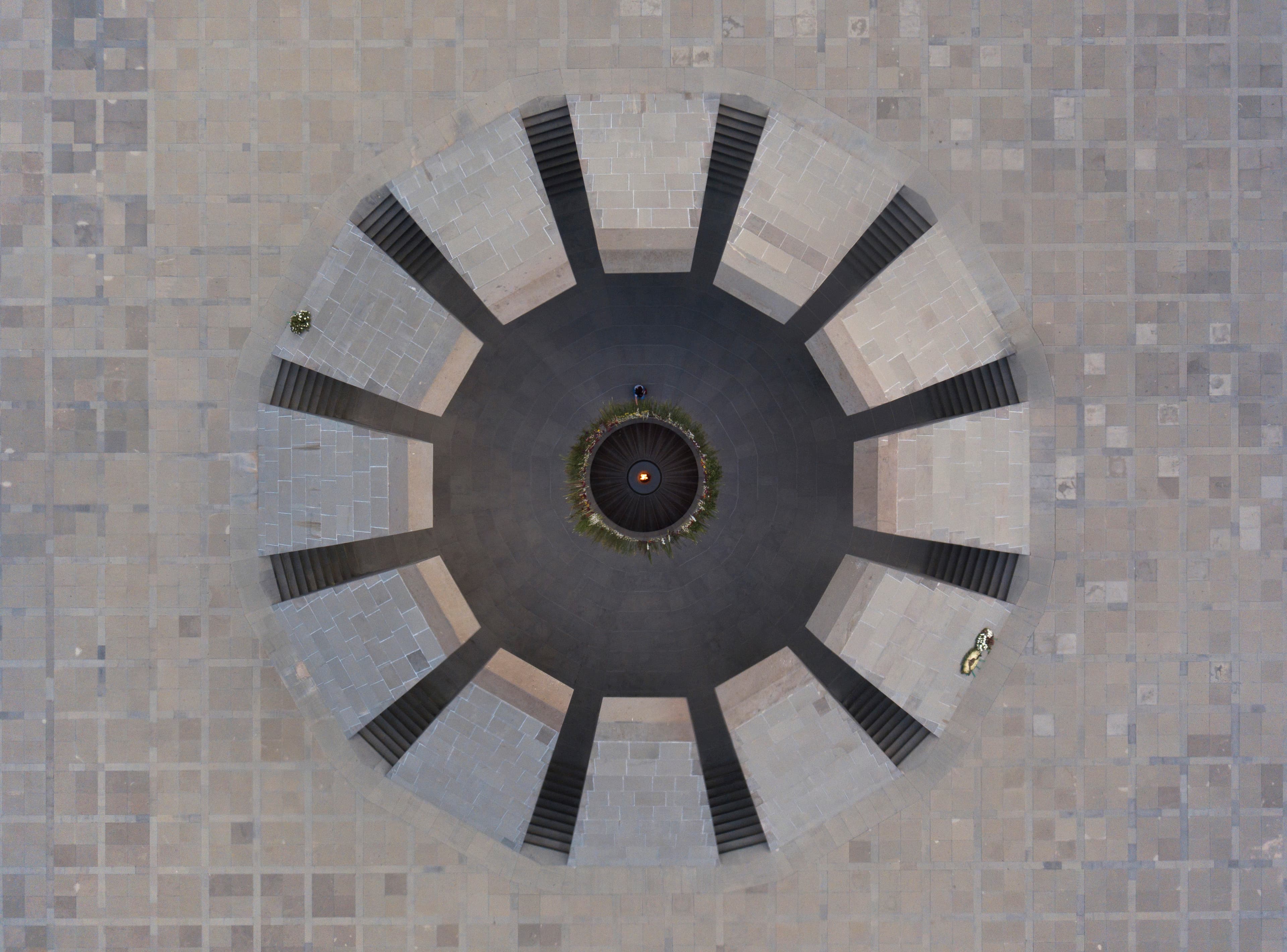
A single flower is enough. The tradition is modest: most people bring one or a few cut flowers — carnations, tulips, or irises are most common, red or white. Vendors stand along the approach from Kievyan and Proshyan streets throughout the day; prices are kept accessible. You do not need a bouquet. You place the flower on the ring surrounding the eternal flame and step back quietly.
The memorial is open to visitors all day and through the night — there is no right time to come. Three moments repeat every year.
Evening of April 23 — torchlit march
A column with torches leaves Republic Square at 20:00 and walks to Tsitsernakaberd via Amiryan Street, Mashtots Avenue, Baghramyan Avenue, and Kievyan Street, arriving late at night. Organized annually by the ARF (Dashnaktsutyun) Armenia Youth Union together with the Nikol Aghbalyan Student Union; it is a large, very visible moment.
Morning of April 24 — official ceremonies
State leadership (the President, the Prime Minister, the Speaker of Parliament) and foreign delegations lay wreaths at the eternal flame in the morning; separately, the Catholicos of All Armenians from Holy Etchmiadzin performs a memorial rite of intercession. During the official-delegation window (traditionally around 09:00–10:00) the area near the flame is temporarily cordoned; expect the heaviest crowds before noon.
The rest of the day — the people's procession
From late morning until deep into the night, a continuous stream of people walks the alley to the flame. It is the quietest, densest part of the day — the queue moves but you will wait. The evening and early hours of the night are thinner and often the most reflective.
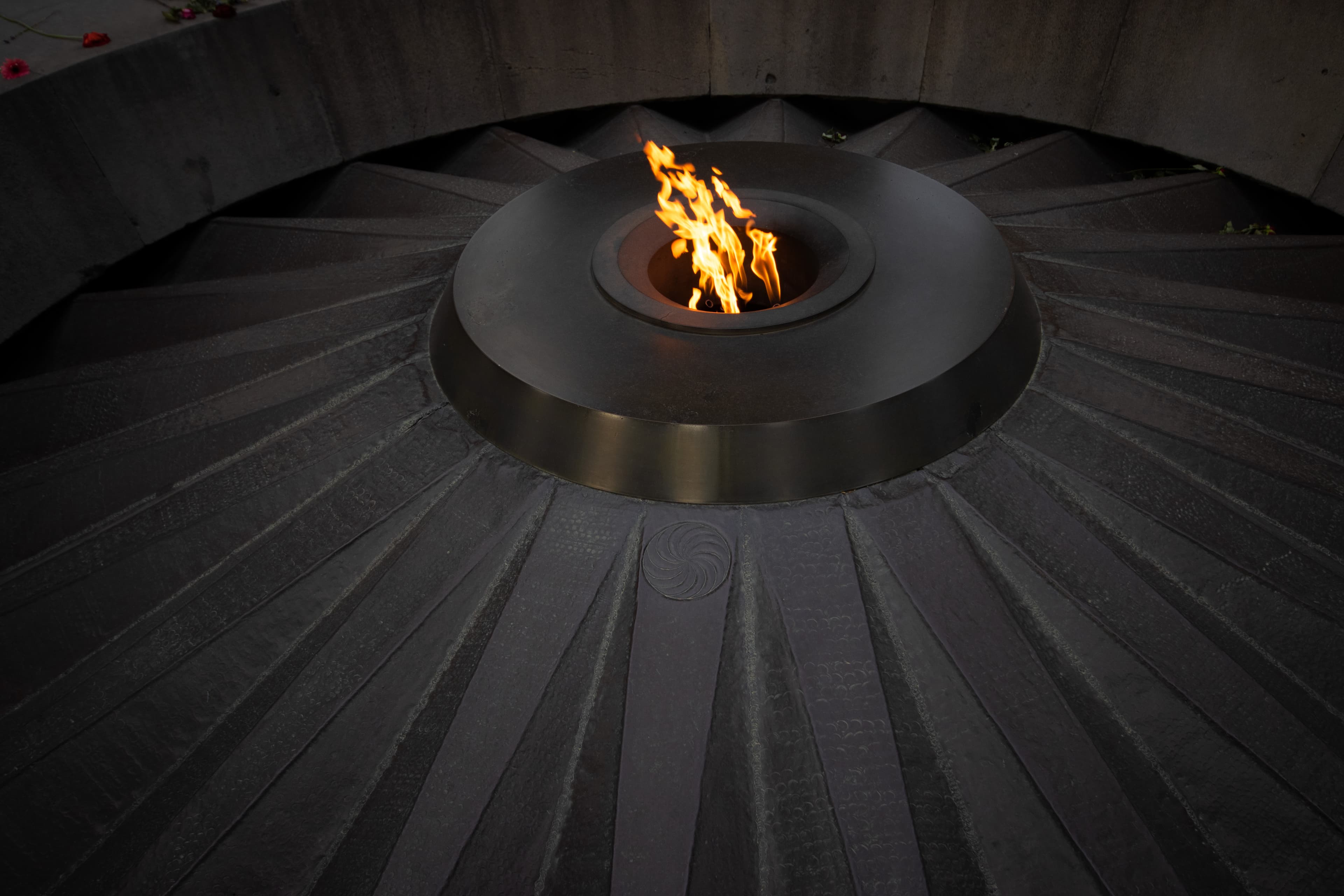
A few quiet rules — not enforced by anyone, observed by almost everyone.
- Keep your voice low. Soft music plays from loudspeakers above, and most people walk in silence.
- Follow the flow. The approach narrows to a slow single-file procession: you descend the steps between the slabs, lay the flower near the flame, and keep moving so the person behind can take your place. Don't push against the line.
- Place the flower on the ring of flowers already encircling the flame and keep moving — on April 24 the line can take an hour or more, and it flows only while people don't linger.
- Photographs are welcome, the day is widely photographed — but keep them off mourners' faces, and most feel a posed smiling selfie at the flame itself doesn't fit the day.
- Dress is respectful rather than formal. You will see many people in dark or subdued colors; many also wear the purple-and-black forget-me-not pin, the official symbol of remembrance. No one will be stopped for what they wear.
The approach is paved but uphill; wheelchairs and strollers can reach the flame, though some sections are steep. On April 24 the queue is long and the sun on the open plateau can be strong — take water. Children are welcome; the day is quiet but not frightening, and bringing them is itself an act of memory.
We lean on independent, internationally respected sources rather than on any single state position. Every historical claim on this page traces back to at least one of the references below. If you want to question a number or a date, start here.
Historical context
- US Holocaust Memorial Museum — Armenian GenocideEntry in the USHMM's Holocaust Encyclopedia. An independent American institution; widely considered the most methodologically rigorous non-Armenian English-language reference on the events.
- Encyclopædia Britannica — Armenian GenocideStandard reference work entry. A neutral starting point with dates, numbers, and historiography, including the range of scholarly estimates.
- International Association of Genocide Scholars — resolutionsFounded in 1994, IAGS is a leading international academic association of genocide researchers and co-publishes the peer-reviewed journal «Genocide Studies and Prevention». Its 1997 resolution (Montreal) unanimously recognized the Armenian Genocide; the 2007 resolution extended recognition to the Ottoman genocides against Assyrians and Pontian/Anatolian Greeks, with the support of over 80% of members who voted.
- Whitaker Report to the UN Sub-Commission (1985)Study E/CN.4/Sub.2/1985/6 by UN Special Rapporteur Benjamin Whitaker on the prevention and punishment of genocide. Paragraph 24 lists «the Ottoman massacre of Armenians in 1915–1916» among qualifying genocides of the twentieth century. On 29 August 1985, at its 38th session, the UN Sub-Commission on Prevention of Discrimination and Protection of Minorities took note of the report by a vote of 15 in favor, 1 against, and 4 abstentions. This is not a UN resolution — it is a commissioned study — but it is the earliest UN-system document to name the Armenian Genocide as such.
- European Parliament resolution of 15 April 2015Centenary resolution adopted by a supranational, non-Armenian legislature. Formally recognizes the Armenian Genocide and calls on Turkey to come to terms with its past.
- Armenian Genocide Museum-Institute — the Armenian GenocideState museum at Tsitsernakaberd and primary Armenian authority on the Genocide. Source for the figure of ~800 arrested on 24 April 1915 and following days, for the ~1.5 million death toll, for the memorial complex and the museum's own archives.
- Armenian National Institute — countries that recognize the Armenian GenocideWashington-based institute. Maintains the most cited list of state-level recognitions of the Armenian Genocide; as of 2025 it enumerates 32 countries by name, plus the European Parliament and the Holy See.
- Wikidata — Tsitsernakaberd (Q154775)Machine-readable, cross-referenced entity: verified construction year (1967), architect, coordinates, OSM relation (1627860), and links to 35 Wikipedia language editions.