Vardavar. Yerevan's water day, and how to enjoy it
The one day the whole city has permission to soak you. What Vardavar is, how it is actually played out in Yerevan, and — most of all — how to protect your phone, your eyes and yourself while having the best day of the summer.
Vardavar is, for many, the best day of the Yerevan summer. For one day the whole city has silent permission to soak anyone — strangers, neighbors, tourists, even the police. Water comes from balconies, passing cars, buckets, hoses and an arsenal of water guns. Resistance is pointless and taking offense is bad manners. So the only sane plan is this: expect to get soaked, guard the two or three things that genuinely can't get wet, and enjoy the rest. That's the whole point of this page — the fun, minus the ruined phone.
Vardavar always falls 98 days (14 weeks) after Armenian Easter, so every year it lands on a different July Sunday. Step through the years to see the date.
You cannot out-run the water, but you can waterproof what matters. The rule of thumb from people who do this every year: if you would be upset to see it ruined, either seal it or leave it at home. The ideal thing to carry is a phone you could afford to lose or break, sealed in a zip-lock, plus a little cash — and nothing else.
Phone and electronics
This is the most common casualty of the day. Counter-intuitively, a newer phone with an IP67/IP68 rating shrugs off a splash far better than an old phone with no water seal — but even a rated phone is not built for a bucket to the face or a pressurized hose, that resistance fades as the phone ages, and liquid damage usually is not covered by warranty. So do not trust the rating: double-bag any phone in zip-locks or use a proper dry pouch, and it will come out of a full bucket dry. Leave the camera, laptop, smartwatch, earbuds and spare car fob at home.
Money and documents
Do not carry your passport into the crowds — leave the original at home and take a copy if you truly need ID. Keep a small amount of cash in a zip-lock. A waist pouch sits more securely than a cord around your neck, which can be knocked loose in the crush.
Eyes, glasses and contact lenses
A hose or bucket to the face stings and can knock off glasses, so use a strap. The bigger, less obvious risk is contact lenses: any untreated water on a lens — tap, fountain, bucket — carries a small but real risk of a painful, sight-threatening eye infection. Wear glasses instead, or daily disposables you throw away the moment you get home. Try not to let doused water sit in your eyes; rinse with clean water if it does.
Shoes and footing
Wet stone plazas, marble steps and slick flip-flops are how people actually get hurt on Vardavar — not from the water itself. Wear closed shoes with grip. Skip smooth-soled sandals, and watch your step near fountains, the Cascade and Swan Lake, where the stone stays wet all day.
What to wear
Quick-drying clothes in darker colors. Avoid white or thin cotton — it turns transparent when soaked. Many people wear swimwear underneath. Bring a small towel and a full change of dry clothes, and leave them somewhere safe (a car, a bag at a café, your hotel) for afterwards. A hat helps against both sun and surprise buckets.
Vardavar is, almost always, a happy and safe day — over 160,000 people celebrated in 2025 without any serious trouble. But a handful of risks are real, and a couple of the scarier stories are pure myth. Let's sort out which is which.
"You'll catch a cold from the water" — mostly a myth
Getting wet does not, by itself, give you a cold — colds are viral. What can genuinely make you unwell is staying in cold, wet clothes for hours until you are properly chilled — especially children, who lose heat faster — plus close crowds passing viruses around. So the fix is simple: dry off and change out of wet clothes before you get cold, and don't spend the whole day shivering.
Dirty water is a real risk
Not everyone douses with clean tap water — some fill buckets from fountains, canals or standing puddles. Swallowing that, or getting it in your eyes, nose or an open cut, can cause a stomach upset or a skin, ear or eye infection. Keep your mouth shut when a bucket lands, don't drink it, and if a fever, vomiting or eye pain follow in the next days, see a doctor.
Ice water and cold-water shock
A bucket of ice-cold water dumped on someone from behind triggers an involuntary gasp and a jump in heart rate. For a healthy adult that's mostly just a nasty shock — but the same jolt is a genuine risk for the elderly or anyone with a heart condition, and for anyone the startle itself is dangerous at the edge of a pool, fountain or lake, where a flinch can end in a fall. So don't ambush strangers with ice water, and never right at the water's edge.
The road: don't douse drivers or riders
Every year the Interior Ministry goes to enhanced duty, with road police reinforced on the Yerevan–Sevan highway. The reason is obvious: a bucket through a car window or a blast at a motorcyclist, cyclist or scooter rider can cause a crash. Don't throw water at anything moving. If you're driving, keep the windows up, and if you get hit, don't slam the brakes.
Open water is the real danger
This is the part most people underestimate. The street water fight almost never hurts anyone. Where people actually die on Vardavar is in lakes and reservoirs — in 2025 there were two drownings, both at unguarded spots, none in supervised zones. If you head to Lake Sevan or a river to cool off, swim only where there are lifeguards and water patrols, and never after drinking.
Water bombs from above
A tied plastic bag of water dropped from several floors up carries real force — enough to genuinely hurt someone it lands on. If you're throwing, don't drop from height onto people or the road below; if you're walking, don't linger directly under balconies in the busy neighborhoods.
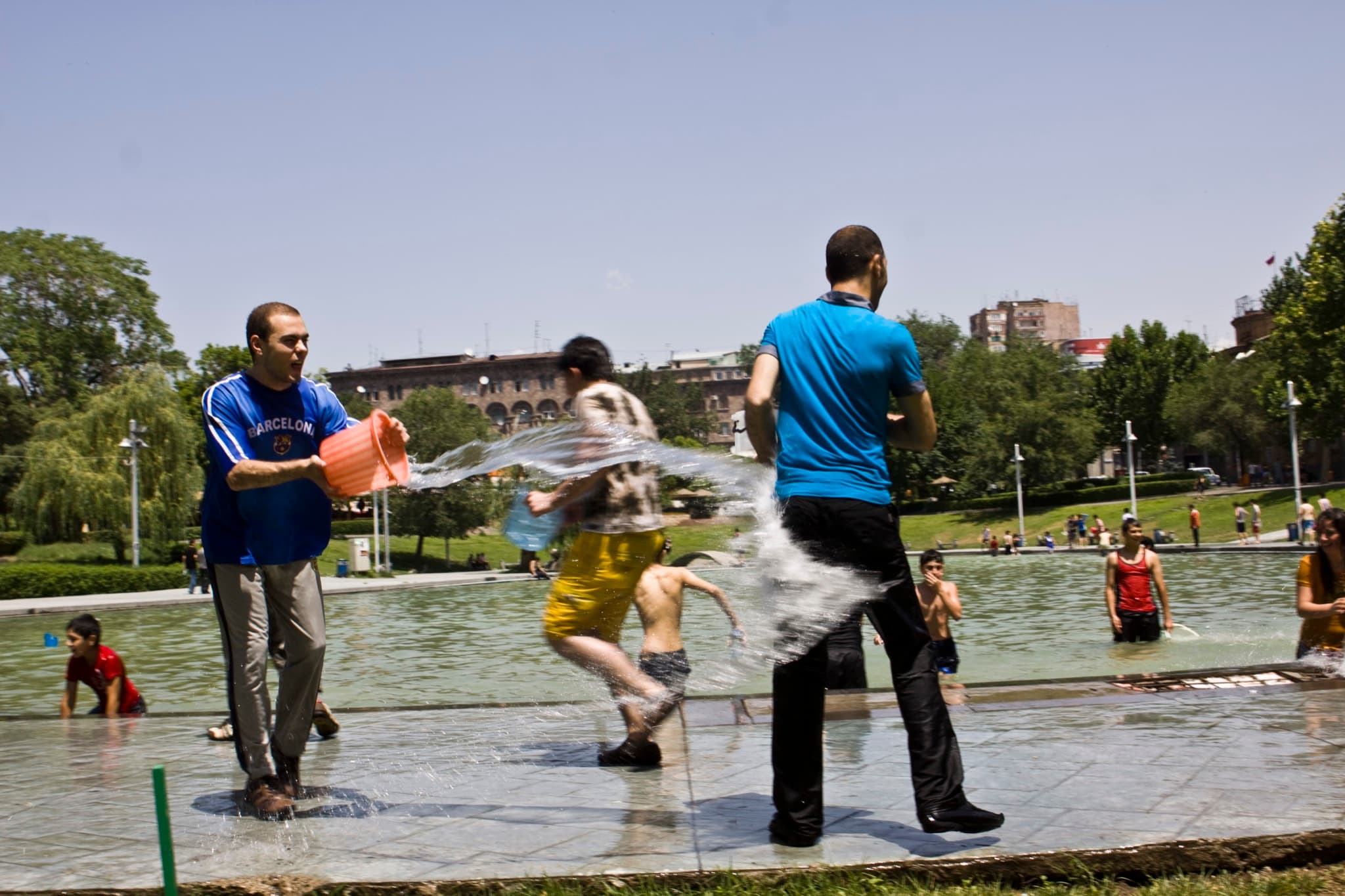
There are no teams and no rules — the whole city is the game. Water arrives from every direction: kids with balloons, teenagers with super-soakers, shopkeepers with a hose, a bucket from a passing car, a wall of water off a balcony as you walk down the avenue. Even ducking into a café won't save you. And everyone agrees on exactly one rule: you don't get to take offense.
Yes, you can even douse a police officer
The legend is basically true: on Vardavar the police tolerate being splashed and often join in themselves — fire trucks and police hose the crowds down on Republic Square, and those jets are memorably cold. So a friendly splash at an officer is part of the day. What that does not mean is a free pass for anything else: it's a truce over water, not over behavior.
Consent still matters
Not everyone is playing, and the tradition has a gentler side that most people keep to on their own: leave alone the elderly, small babies, someone clearly on their way to work in office clothes, a person carrying groceries, a laptop or an instrument, and anyone who signals they don't want it. The spirit of the day is shared joy, not a soaking forced on someone who's having a hard moment.
If you truly can't get wet today
Be honest with yourself: asking the crowd nicely almost never works, and "I have a phone" is often taken as an invitation. The only reliable way to stay dry is to not be on the street during the day — take a taxi door to door, keep the windows up, and move early in the morning before it peaks. Don't schedule meetings or anything that needs you presentable.
Vardavar always lands on a warm July Sunday (see the exact date above). Whichever year you come, the water builds through the day in the same familiar order.
Early morning — the calm window
Church services and the quietest streets. If you need to get somewhere dry — the airport, a train, work — this is your window. Children start early, but the citywide battle hasn't yet reached full force.
Midday to afternoon — the peak
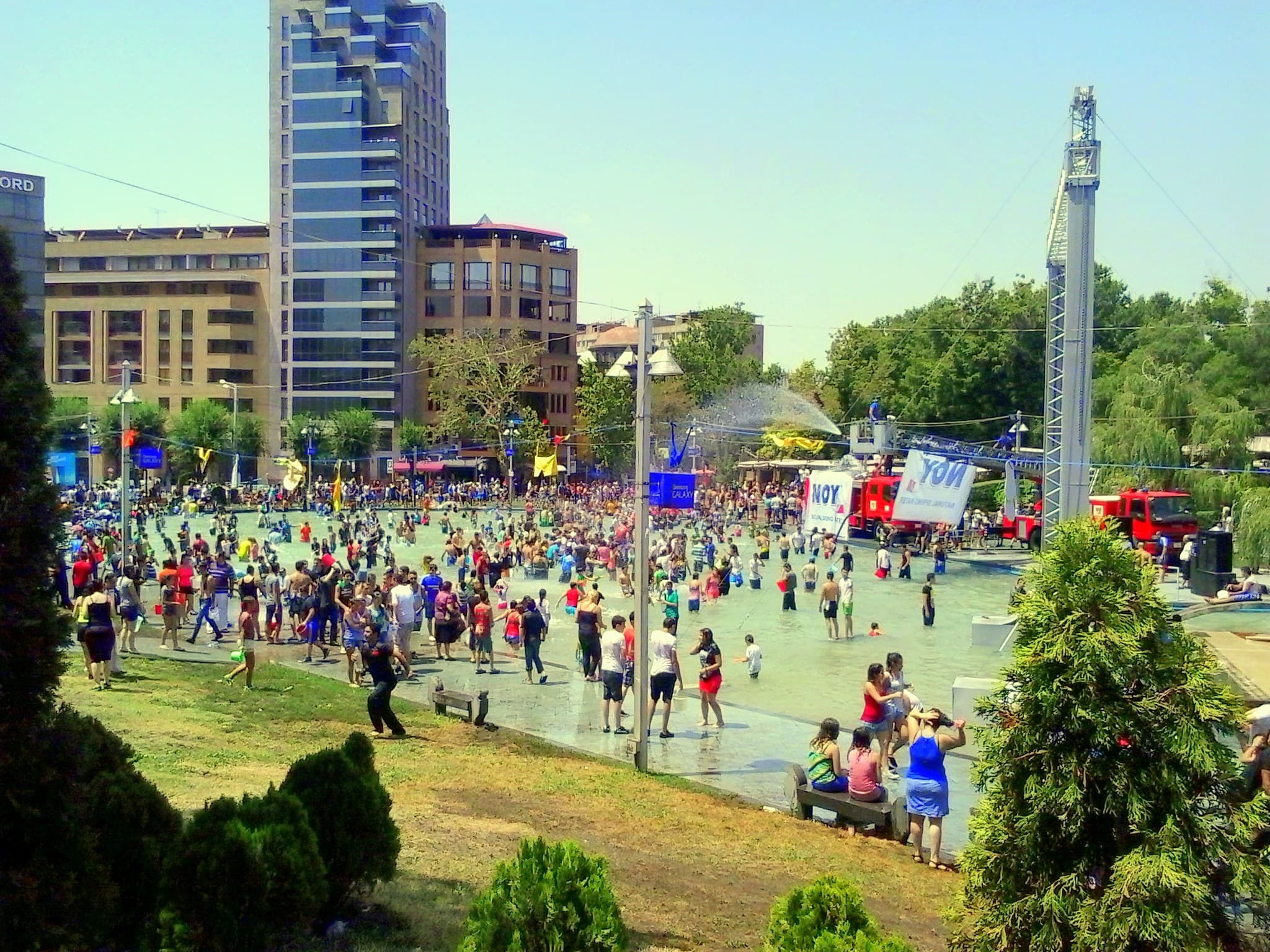
The full free-for-all. Republic Square, Swan Lake and the central parks are packed, the city's water trucks are out, and there is no dry route through the center. On 12 July 2026 the square and adjacent streets are closed to cars from 07:00 to midnight, with a dedicated children's area near the Stepan Shaumyan monument. This is the time to be all-in or stay home.
Evening — the taper
As the air cools, the dousing eases off and the day winds down into concerts and dry clothes. By nightfall the streets are calm again — a good time to come out if you sat out the peak.
The dousing is heaviest around water — fountains, the lake, the squares. Steal a move from the locals: treat the city's drinking fountains (pulpulaks) and the big fountains as refill and rally points, and hop between them. Below are the spots to seek out, or to steer around if you're trying to stay dry.
- Republic SquareThe epicenter. The city's official celebration runs here — water trucks, a stage, DJs and thousands of people. On 12 July 2026 the square and the streets around it are closed to cars from 07:00 to 24:00. Come to be in the thick of it; avoid it if you want to stay remotely dry.
- Swan Lake (near the Opera)The shallow pond by the Opera House, usually off-limits for wading, becomes a splash zone on Vardavar — crowds wade in and the city hoses them down. Reliably one of the wettest spots in the center.
- The CascadeThe monumental stairway and the streets at its foot draw crowds with water guns and buckets. Watch your footing — the stone steps are slick when wet.
- Lovers' Park & central boulevardsThe parks and tree-lined avenues along Mashtots and Baghramyan are classic ambush territory: kids with balloons, teenagers with super-soakers, and water arriving from balconies overhead as you walk.
- Lake Sevan (outside the city)The biggest crowds in the country gather at Sevan — over 50,000 people in 2025. It is also where the day's real danger lives: drownings happen almost every year at unguarded stretches of shore. Swim only where lifeguards and water patrols are posted.
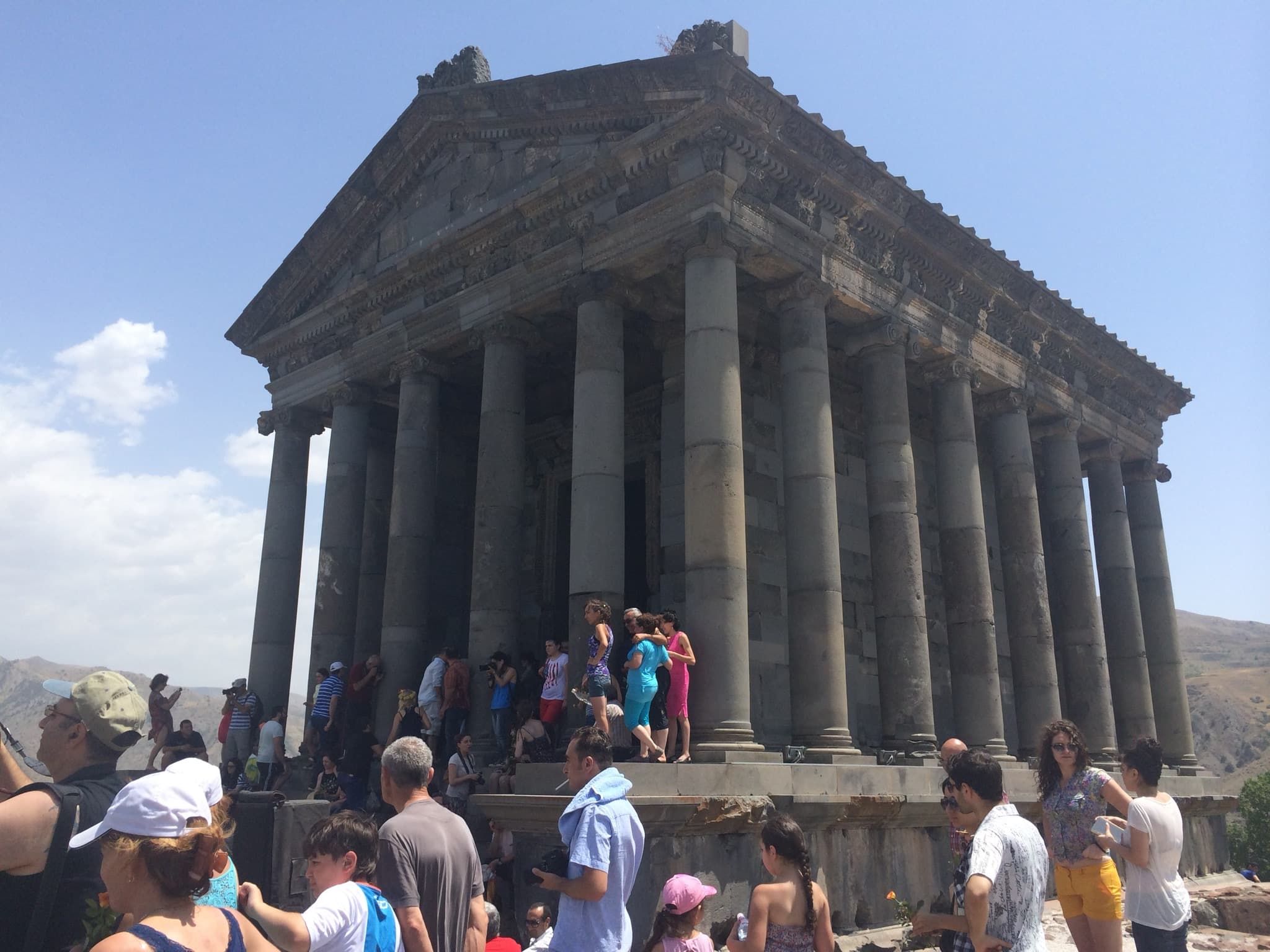
The water fight is the visible tip of a festival far older than it looks — one that reaches back before Christianity and was folded into the church calendar rather than replaced.
- A goddess of water and roses
In pre-Christian Armenia the festival honored Astghik, goddess of water, beauty, love and fertility — paired with Vahagn, the warrior god of thunder. It was a midsummer fertility rite: water was sprinkled to bless the harvest, and roses and doves, Astghik's emblems, gave the day its imagery. Both the rose (vard) and the water survive in the festival we have today.
- What the name means (nobody fully agrees)
"Vardavar" is vard (rose) plus -var, and the second half is genuinely contested. Popular readings are "the burning of the rose" and "showering with roses" or "rose-water"; some linguists trace -var to an old Indo-European water root. Treat the poetry as poetry — what's certain is that roses and water sit at the heart of the name.
- How the church kept it
After Armenia's conversion, the church absorbed the old festival rather than banning it, mapping it onto the Feast of the Transfiguration of Christ (Baydzarakerputyun) and reinterpreting the dousing as a washing-away of sin. As a moveable feast it lands 98 days after Easter — always in July — which is why the date shifts each year. Releasing doves, a nod to Astghik and to the story of Noah, is still part of the more traditional celebrations.
A few notes for specific situations.
With kids
It's one of the happiest days of the year for children. Dress them in quick-dry clothes and water shoes, bring towels and a full change, keep them close in crowds, and mind the slick stone near fountains. Watch out for the ambush classics: balloons, hoses and buckets from above.
Tourists
You will be targeted — sometimes precisely because you look like a visitor. You can't dodge it, so just play along; it's all meant kindly. If you'd rather have the calm, cultural side, spend the morning out of the center and come back in the evening once it winds down.
With pets
There's no tradition of dousing animals, but the crowds, fire hoses and sudden buckets are stressful and a soaked, panicked dog in a dense crowd is a real hazard. Walk dogs early on quiet residential streets and skip Republic Square, the parks and Swan Lake during the peak.
Nobody enforces these, and almost everybody keeps them. They're what turns a citywide soaking into a good day for everyone.
- Take it with good humor. If you get soaked, laugh it off — anger is the only real faux pas of the day.
- Leave the vulnerable alone: the elderly, babies, and anyone clearly unable to play along.
- Don't aim at faces or ambush with ice water from behind — a friendly splash isn't a blast to someone's eyes.
- Never douse drivers, motorcyclists, cyclists or scooter riders — a startled rider can crash.
- Don't drop water bombs from balconies onto people or the street — the impact can hurt.
The history draws on standard references; the safety and logistics draw on official Armenian advisories, news reports of past Vardavars, and medical bodies. Local practice is cross-checked against what people in Yerevan community chats actually report doing each year.
History and meaning
- Wikipedia — VardavarOverview of the festival's pre-Christian origins, the Christianization into the Feast of the Transfiguration, the contested etymology of the name, and modern practice.
- Wikipedia — AstghikThe Armenian goddess of water, beauty, love and fertility to whom the festival was originally dedicated; her emblems, the rose and the dove, survive in the day's symbolism.
- UNESCO — Vardavar (intangible cultural heritage video)Vardavar is listed among Armenia's intangible cultural heritage; UNESCO's short profile documents the ritual as it is practiced today.
Safety, logistics and scale
- US CDC — Acanthamoeba keratitis and contact lensesWhy untreated water on contact lenses is a genuine hazard: most cases of this painful, sight-threatening eye infection occur in lens wearers. The reason we recommend glasses or daily disposables on Vardavar.
- RNLI — Cold water shockA bucket of ice water or sudden immersion triggers an involuntary gasp and a heart-rate spike that can be dangerous even for healthy people — the reason not to dump ice water on someone from behind, or near open water.
- News Armenia — Vardavar 2025 police reportThe day's official tally: nearly 500 administrative protocols and two drownings in 2025 — both at non-designated swimming spots, none inside guarded celebration zones. Confirms where the real danger is.
- Sputnik Armenia — enhanced police and rescue dutyEvery year the Interior Ministry moves to enhanced duty, concentrating road police and water patrols — especially on the Yerevan–Sevan highway and the lake — and asks people to obey traffic rules and respect those who don't want to be splashed.
- RIA — Russian Embassy notice on VardavarThe embassy's annual reminder: expect indiscriminate dousing of pedestrians and cars; protect documents, money and valuables in waterproof bags; stay indoors if you don't want to take part.
- Massis Post — 160,000+ took part in Vardavar 2025Scale of the day: the Interior Ministry counted over 160,000 people in active celebration areas nationwide, with no serious breach of public order reported.