Traffic & car dominance
Car dependency
Yerevan has 343,000 registered vehicles, 12,000 more than a year earlier. A wave of cheap imports in 2017-2019 came in the years when bus routes were closing as unprofitable, and the city still does not measure traffic speeds. In 2025 the prime minister called the jams a crisis; the mayor promises restrictions on private cars from 2027.
Facts checked
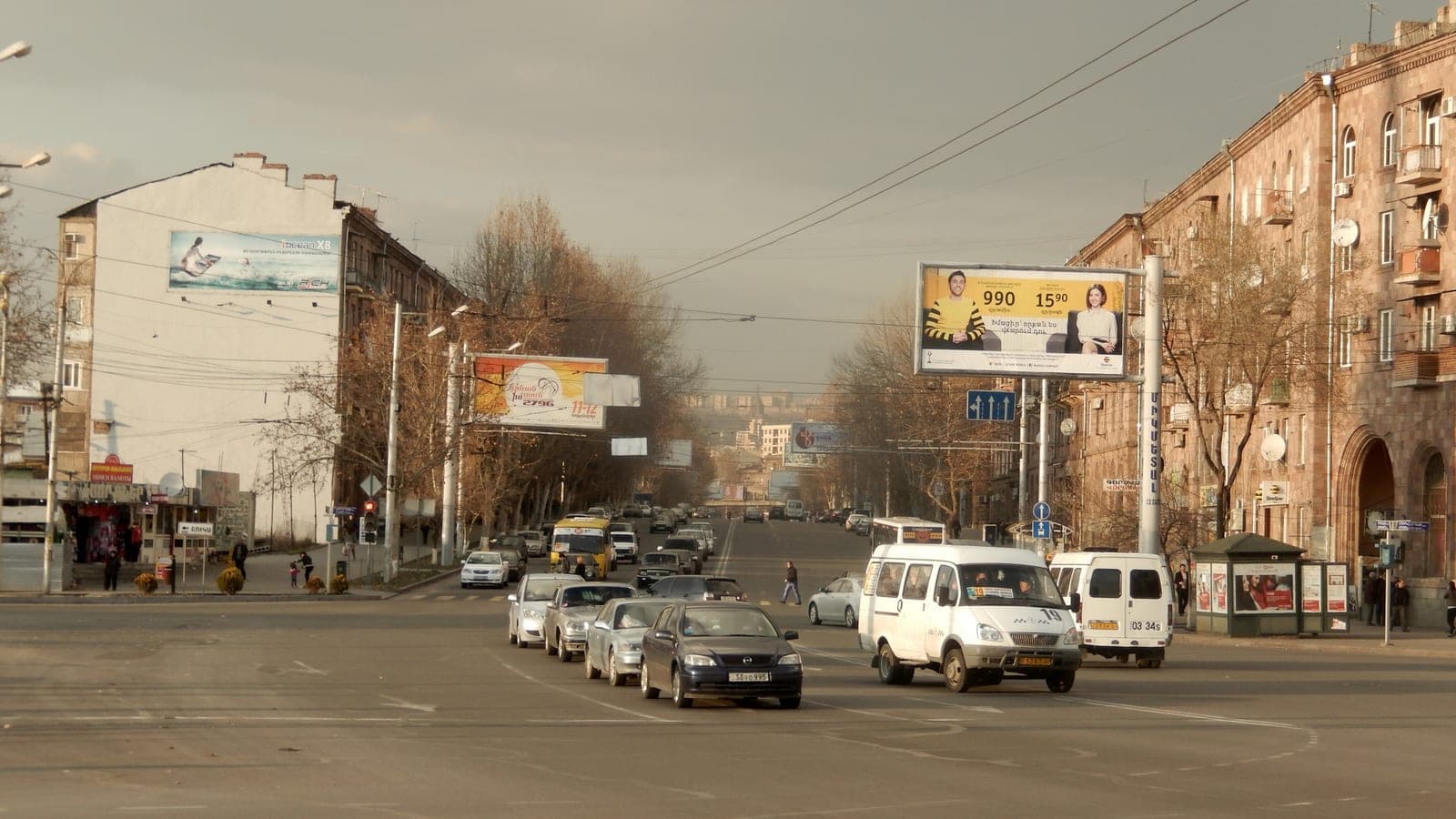
Photo: Armineaghayan · Wikimedia Commons · CC BY-SA 4.0
How it began
Before. Tamanyan's 1924 general plan designed the city for 150,000 residents; by the early 1930s the target had been raised to 400,000. In 2011 the ADB wrote that the closure of the large industrial plants had changed the city's travel patterns, and that only four bridges carry traffic across the Hrazdan to the center. In 1994, when the energy crisis halted surface transport, the metro carried 73 million passengers; in 2009, 17 million.
What changed. A 10% duty on imported cars in 2015-2019 and its rise to EAEU rates from 2020 brought a wave of imports: 34,000 cars in 2017, 140,000 in ten months of 2019. After the failed rise of 2013 the fare stayed at 100 dram until 2025, and operators closed unprofitable routes.
The urban planning culture of Soviet Armenia in the 1920s and 1930s — Известия АН Армянской ССР. Общественные науки, 1960
Sector Assessment (Summary): Urban Transport, Sustainable Urban Development Investment Program (RRP ARM 42417) — Asian Development Bank, March 25, 2011
Armenia's automobile boom and the car dealers who brought thousands of old cars into the country — JAMnews, November 12, 2019
V. Harutyunyan, Reforms of Yerevan Transport System in the Context of Low-Carbon Development Policy — EU4Climate (UNDP, EU), 2020
Increased public transport fares suspended in Yerevan — Caucasian Knot, July 25, 2013
Timeline
- Origin
The earliest record found: more and more traffic in the capital
Reporting on the traffic police's new cameras, Azatutyun describes increasingly heavy traffic, particularly visible in the capital. We found no earlier report of congestion in Yerevan.
- Decision
The traffic-police chief promises to solve the jams 'in the near future'
The promise was made at a government briefing; ARKA published it on 29 June 2007.
- Development
ADB: 15% of the street network runs over capacity
In 2006 traffic on 15% of the city's network exceeded its capacity, and on a further 35% it reached 70% of it. Only four bridges carry traffic across the Hrazdan to the center, and the traffic lights operate without coordination. In December 2009, 128,500 cars were registered in Yerevan, 40% of the country's vehicles.
- Decision
A new paid-parking procedure: 100 dram an hour, 12,000 a year
A private company films the violations and the police issue the fines. In August Mediamax reported that there was no contract or written agreement between the police and City Hall on the arrangement.
- Civic action
The fare rose to 150 dram and went back to 100 five days later
WinCity Hall published the decision after it had already taken effect. After protests by the 'We won't pay 150 dram' campaign, the mayor suspended it on 25 July. The 100-dram fare lasted until February 2025.
- Development
A new route network: up to $200M and 400 fewer minibuses
The network designed by the UK firm WYG, for which the city paid $850,000, was preliminarily estimated at up to $200M; as a first step about 400 minibuses were to leave the network from 2020.
- Development
Car imports quadrupled ahead of higher duties
From 2015 the duty on a car imported into Armenia stayed at 10% regardless of age or engine size; from 2020 it rose to EAEU rates. 34,000 cars were imported in 2017, 64,000 in 2018 and 140,000 in ten months of 2019. In the traffic police register, the number of vehicles in the country grew 11% in 2019 and 34% in 2020.
- Development
Routes close because the fare does not rise
The EU4Climate report explains the route closures this way: under a 2001 government decree the operator proposes the fare, but the community holds back its rise, and routes close as unprofitable. In the same year 319,626 vehicles were registered in Yerevan, 279,640 of them cars.
- Media
City Hall and the police: street loads have never been measured
Asked by Novoye Vremya, City Hall and the traffic police said no studies of traffic or of road loads at rush hour had been done: there was no counting equipment and no specialists.
- Development
The 11th metro station — years and millions away
The design of the Ajapnyak station alone costs about $4M, and building it will take several years. The metro has not been extended since 1996.
- Decision
- Decision
Parking in the center costs more: 300 dram an hour, 160,000 a year
Annual payments over 10 months fell to 7,674 from 45,342 a year earlier. Courts have invalidated the fee decisions of earlier years; City Hall charges under rules adopted separately for 2026.
- Milestone
The new network and a 150-dram fare
The new route network has run since January 2025: the fleet was cut from 1,922 vehicles to 845, and by November 2024 the city had bought 649 new buses. Since February a ride costs 150 dram. The 2025 fare shortfall was preliminarily put at 5.5 billion dram; the government gave City Hall 3 billion from its reserve fund, and the mayor said 30 of the 45 planned trolleybuses could not be bought.
- Development
343,220 vehicles in Yerevan, up 11,906 in a year
Vazgen Harutyunyan, head of City Hall's transport department, gave 953,965 vehicles registered in Armenia and 343,220 in Yerevan (as of 1 September 2024, as published). Over a year their number grew by 44,639 nationwide and 11,906 in the capital. In December 2025 the minister put the country's registered vehicles at a million.
- Decision
Pashinyan: traffic is a 'crisis'
The PM called the situation on the roads a crisis 'in the literal sense' and announced an inter-agency group. On 27 November he ordered two working groups, one on air pollution and one on traffic.
- Milestone
Traffic Management Center established
OngoingCouncil of Elders decision No. 456-A; the center was registered on 5 January 2026. In July 2026 the former head of the transport department, Edgar Galstyan, said the situation on the roads had not improved.
- Decision
The traffic working group: 20 people under a deputy prime minister
By Decision No. 1143-A the Prime Minister created an inter-agency group chaired by Deputy Prime Minister Tigran Khachatryan. Its members include the ministers of internal affairs, territorial administration and education, the chair of the Urban Development Committee, deputy mayor Suren Grigoryan and the head of City Hall's transport department, three police colonels, the rector of the Yerevan State University of Architecture and Construction, the Bureau of Motor Insurers, the National Road Safety Council, the Automobile Federation and a Vanadzor drivers' club. No organization of passengers, pedestrians or cyclists is on the list. The group's head must report to the Prime Minister every 15 days and inform the public widely every month. At the first session the same day Khachatryan told the agencies to propose short-term measures.
- Update
The working group's last report
On 19 December Khachatryan told officials to turn the proposals into an action plan by early 2026. On 29 January he told a government session that a preliminary list of measures would go to City Hall the following week. On 19 March the group discussed driver discipline, the rules on stopping and parking, truck traffic and the refuse-collection schedule. As of 14 October 2026 the government's site carries no other session reports, and we found neither the plan nor the list published.
A regular session of the interdepartmental commission on traffic regulation and overcoming congestion was held — Government of Armenia, December 19, 2025
Avinyan proposes solutions to relieve traffic congestion in Yerevan — amnews.am, January 29, 2026
- Update
Avinyan: restrictions on cars from 2027
OngoingThe mayor expects preliminary study results in September-October and implementation in 2027. On 6 July he added that parking at the city's entrances and fast public transport would come first, and called rumors of a car ban untrue. A taxi driver told Azatutyun the jams now last around the clock.
Yerevan plans new traffic measures, including car restrictions, to ease congestion — Armenpress, June 12, 2026
Yerevan to restrict passenger cars — Avinyan — ArmTimes, June 12, 2026
Large car parks to appear at the entrances to Yerevan — PAN.am, June 29, 2026
Ever-worsening jams — a major challenge for Yerevan residents — Azatutyun (RFE/RL), July 3, 2026
The pace of car growth already demands action — Avinyan — Aravot, July 6, 2026
- Update
Ajapnyak station: $287M instead of $50M, and talks with Russia
OngoingThe government approved the project in summer 2026. City Hall put the cost in April at $287M against about $50M in 2022, mostly because of a bridge across the Hrazdan gorge. In late 2025 the station's money went to 45 trolleybuses. Construction has not begun.
- Update
The mayor: bus lanes on all main routes and cameras against parking on the roadway
OngoingBy the mayor's account, when two lanes of three-lane Myasnikyan Avenue are blocked, average speed falls from 22 to 8 km/h; who measured this was not said. The Public Order Protection Service was given two months to set up the recording of parking violations.
How many vehicles are registered
Neither the Statistical Committee nor the police publishes the vehicle register by year. Below are all the figures we found, each with its source. The points are not joined by a line: they come from different documents, and their dates and definitions do not always match.
Where Yerevan and the whole country are counted on the same date, Yerevan holds 38% of registered vehicles (2020) and 36% (September 1, 2024).
Registered vehicles, 1993-2025
Thousands of vehicles. A figure with no day is placed in the middle of its year.
A hollow circle is a round figure or an estimate.
Sources: UNECE, World Bank, Azatutyun (RFE/RL), FIP.am, EU4Climate (UNDP, EU), amnews.am, Sputnik Armenia
yfp.am/en/topics/traffic-congestion#vehicle-fleet-chart
 Yerevan for People
Every figure and its source (21)
| Date | What was counted | Number |
|---|---|---|
| December 31, 1993 | Armenia, passenger cars | about 282,000 |
| December 31, 1994 | Armenia, passenger cars | about 269,000 |
| December 31, 1995 | Armenia, passenger cars | about 258,000 |
| December 31, 1996 | Armenia, passenger cars | about 247,000 |
| December 31, 1997 | Armenia, passenger cars | about 263,000 |
| 2008 | Yerevan, all vehicles The World Bank calls this an estimate and does not name its source. | about 160,000 |
| January 1, 2012 | Armenia, all vehicles Figures from the Prosecutor General's Office. | 445,023 |
| January 1, 2012 | Armenia, passenger cars | 338,655 |
| January 1, 2013 | Armenia, all vehicles | 483,614 |
| January 1, 2013 | Armenia, passenger cars | 388,043 |
| 2013 | Armenia, all vehicles From the Road Police's electronic register; no date within the year is given. | 528,643 |
| 2018 | Armenia, all vehicles | 630,170 |
| 2019 | Armenia, all vehicles | 702,330 |
| 2020 | Armenia, all vehicles Including 32,446 vehicles registered in Artsakh. | 850,691 |
| 2020 | Armenia, passenger cars | 726,026 |
| 2020 | Yerevan, all vehicles Traffic Police register data for 2020, with no exact date. | 319,626 |
| 2020 | Yerevan, passenger cars Traffic Police register data for 2020, with no exact date. | 279,640 |
| December 31, 2022 | Armenia, all vehicles Vehicles 'in operation' on the Road Police register; whether this matches 'registered' at the other points is not known. | 888,110 |
| September 1, 2024 | Armenia, all vehicles The date is as given in a September 2025 report, which also gives the year's growth. We have not established which of the two Septembers was meant. | 953,965 |
| September 1, 2024 | Yerevan, all vehicles The date is as given in a September 2025 report, which also gives the year's growth. We have not established which of the two Septembers was meant. | 343,220 |
| December 26, 2025 | Armenia, all vehicles The Interior Minister gave a round figure on the program 'Citizen Asks'; the date is the day she spoke. | about 1,000,000 |
Promises & what happened
- Traffic PoliceBroken
«Solve Yerevan's traffic-jam problem 'in the near future'.»
18 years later the prime minister called the situation on the roads a crisis.
- Yerevan Municipality, Tigran Avinyan — Mayor of YerevanBroken
«Build the 11th metro station, Ajapnyak.»
Said: November 27, 2021 · Azatutyun (RFE/RL)Deadline: construction was promised to start in 2024Checked: October 14, 2026In 2024 CivilNet reported that construction would not begin before 2026. In late 2025 the station's money went to 45 trolleybuses. In summer 2026 the government approved the project at $287M (it was put at about $50M in 2022); as of October 2026 construction has not begun.
- Tigran Avinyan — Mayor of Yerevan, Yerevan MunicipalityPending
«Buy 250 18-meter electric buses to replace the HIGER buses and GAZelle City minibuses — the 'final phase' of the fleet upgrade, about 98 billion dram on loan.»
Avinyan, then deputy mayor, first spoke of 250 electric buses in August 2023, counting on EBRD money; by City Hall's answer as relayed by Yerevan Community, the purchase was in the plan for 2024. On 1 July 2026 the State Investment Committee approved the program, a consultant backed by the ADB is preparing the tender documents, and 12-meter buses are under study in place of 18-meter ones. As of October 2026 not one electric bus has been bought.
Yerevan intends to purchase 250 electric buses with EBRD funding — ARKA
Yerevan prepares to purchase 250 electric buses — procurement slated for 2026 — ARKA, December 15, 2025
Official answer on the 250-electric-bus program: promised since 2023, in the 2024 plan — still no buses — Yerevan Community, July 9, 2026
- Tigran Khachatryan — Deputy Prime Minister of ArmeniaBroken
«The head of the working group reports results to the Prime Minister every 15 days and informs the public widely every month.»
In ten months the government's site has carried three reports on the group's sessions, the last dated 19 March 2026. The reports to the Prime Minister are not published and cannot be checked.
- Tigran Khachatryan — Deputy Prime Minister of ArmeniaUnverifiable
«Analyze the participants' proposals and sum them up in an action plan by early 2026.»
On 29 January Khachatryan said a preliminary list of measures was ready and would go to City Hall within a week. As of 14 October 2026 we found neither the plan nor the list published.
- Tigran Avinyan — Mayor of YerevanPending
«Have preliminary study results in September-October 2026 and introduce restrictions on cars from 2027.»
Said: June 12, 2026 · ArmenpressDeadline: results by September-October 2026, restrictions in 2027Checked: October 14, 2026As of 14 October 2026 we found no preliminary results. What form the measure will take has not been said.
- Tigran Avinyan — Mayor of YerevanPending
«Regularly publish the data collected by the Traffic Management Center.»
As of 14 October 2026 the center's page on the City Hall site has no data and links to none.
Claims & fact-check
- Yerevan MunicipalityUnsubstantiated
«After the parking price rise there were somewhat fewer drivers, and this helped clear Kentron.»
In fact: City Hall rests on the number of annual payments: 45,342 over ten months of 2023 and 7,674 over the same period of 2024. Hourly takings grew about two and a half times over the same time, and City Hall did not say how many cars pay by the hour. It gave no counts of cars in Kentron before or after. In the first half of 2026 reports for second-row parking were up 172% on a year earlier.
Said: November 22, 2024 · FIP.amChecked: October 14, 2026 - Tigran Avinyan — Mayor of YerevanUnsubstantiated
«A recent study showed that at rush hour cars in the center move at 10-20 km/h on average.»
In fact: The mayor did not say who carried out the study or how, and it has not been published. In 2021 City Hall and the police said street loads had never been measured. The mayor promised to publish the Traffic Management Center's data, but as of 14 October 2026 there is none. The only systematic source in the dossier is the Yandex.Traffic score: in 2020 the company's analyst put the average weekday score at 5 out of 10.
Said: June 29, 2026 · Sputnik ArmeniaChecked: October 14, 2026Why Yerevan sits in traffic for hours: five causes and even more solutions — Новое время, September 12, 2021
Yerevan Traffic Management Center — Yerevan Municipality
The coronavirus and Yerevan's traffic as seen by Yandex.Traffic — Mediamax, July 1, 2020
Connections
- AmplifiesAir pollutionCDIA, starting a transport study for Yerevan in 2021, wrote that transport accounts for 90% of the air pollutants in the city; the announcement gives no method and no list of pollutants. We found no study that has measured what each source adds to Yerevan's air.
- AmplifiesPedestrian safety & crossingsCars and pedestrians share the same streets. How the city removed crossings and changed speed limits is set out in the pedestrian dossier.
What we don't know yet
- How many cars actually drive in Yerevan. The register counts vehicles by place of registration. In 2020, 319,626 vehicles were registered in Yerevan, and 343,220 in the 2025 report, 23,594 more over four to five years; yet City Hall cites growth of almost 12,000 in a single year. We have not established how these figures reconcile.
- How Yerevan residents get around: what share of trips are made by car, public transport and on foot. We found no published survey from City Hall or from the development banks that fund the city's transport.
- How fast cars and buses move. City Hall publishes no series of street measurements; the figures of 10-20 km/h and 'from 22 to 8 km/h' come without a method.
- How much the city spends on roads and how much on public transport. In Yerevan's budget execution reports 'road transport' is a single line covering roads, stops and buses alike; the City Hall budget portal shows the metro as a separate program, but no bus-operator subsidy under its own name.
- How many of the cars imported in 2022-2023 stayed in Armenia. Some were taken on to Russia and other EAEU countries; we found no year-by-year split between those that stayed and those re-exported.
- What the restrictions on private cars from 2027 will be: a charge to enter, a zone or a plate-number ban. The mayor promised preliminary study results by September-October 2026; as of 14 October we have not found them.
Sources
- Yerevan Traffic Management CenterYerevan Municipalityarchive · August 7, 2026