Tree cutting
Green-space loss
Since 2023 City Hall has been replacing old elms on city streets with young decorative trees, without an environmental review; in November 2025 a court found none was required. The city has 906.8 ha of general-use greenery, 8.3 m² per resident; the general plan for 2005-2020 promised 2,382 ha by 2020.
Facts checked
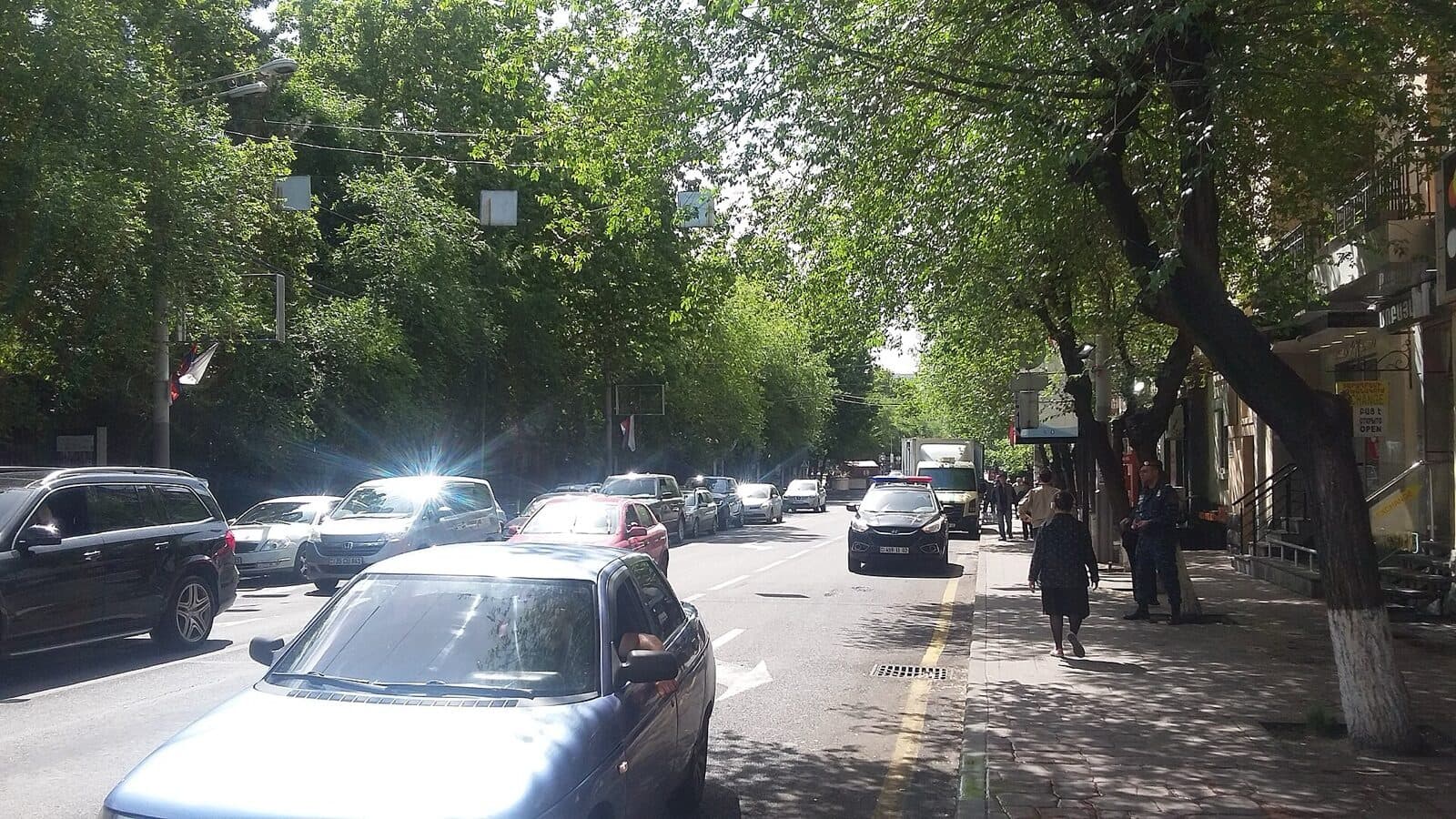
Tumanyan Street, 24 May 2019.
Photo: 23artashes · Wikimedia Commons · CC BY-SA 4.0
How it began
Before. The Soviet city was built to Tamanyan's plan, with a ring of boulevards and forests on the slopes. A 2022 review cites the 1984 inventory: 1,817 ha of general-use plantings, 17 m² per resident. The head of the greening agency gives another figure: 908 ha of green fund in the best Soviet years. We have not established how the two fit together.
What changed. In the energy crisis of the early 1990s trees were cut for firewood, then parks and gardens were taken by cafés and building. People have protested for trees since 2012; the 2023 replacement program drew the largest of these protests.
The history and present problems of Yerevan's green infrastructure — Медицинская наука Армении, 2022
A new green area of 13.5 ha established in Yerevan — Armenpress, December 22, 2025
Yerevan's parks have been seized by government officials — Hetq, October 17, 2003
Timeline
- Origin
Tamanyan's plan: a ring of green streets
The first master plan was drawn for 150,000 residents on 1,105 hectares. Public greenery then covered 2-3% of the city; Tamanyan set aside 10-15% for it: green masses in the Hrazdan gorge and on the Kanaker plateau, and a ring boulevard broken only in the south-west. When it was built, the ring was cut by a third.
- Development
Forests on the Nork and Kanaker slopes
The first slope plantings of 1927-28 died without water. Once an irrigation network was laid, 240 ha of forest were grown on the Nork and Kanaker slopes in 1946-1950; by the end of 1950 there were 300 ha of closed stands and 1,000 ha of young plantings. Two green rings, 16 and 50 km long, were laid around the city.
- Milestone
625 hectares of public greenery
By the start of 1957 general-use plantings had grown 42-fold over 1917, to 625 ha. In those years came the Botanical Garden and Victory Park (1935), Komitas Park (1937), the Opera garden (1939) and the Ring Boulevard (1940).
- Milestone
The 1984 inventory: 17 m² per resident
By the Yergorzelenstroy trust's inventory of 20 December 1984, general-use plantings covered 1,817 ha, 8.15% of the city, or 17.18 m² per resident. The authors of the review we take these figures from note that even this was 1.4 times below the Soviet norm.
- Development
The energy crisis: trees for firewood
In the cold winters of the early 1990s the city's trees were cut for fuel. Hetq wrote in 2003, citing unnamed studies, that 470 ha of trees were cut in Yerevan in 1990-1995. By a 2022 review, public greenery per resident was 9.5 m² in 1991 and 4.9 m² in 2000. For the whole country, one academic estimate puts forest cover down from 11.2% to 7-8% by 2000; the official FAO series still shows about 11.7%.
Evolution of the forest cover in Armenia — International Forestry Review, 2005
Forest area (% of land area): Armenia — World Bank / FAO
- Development
Cafés in the parks
The Social-Ecological Association estimates the greenery lost in the building boom at more than 700 ha. The environment minister says protecting trees in the city is the municipality's job. Former mayor Robert Nazarian admitted in 2003 that almost all café owners in the center had taken more land than they were given. In February 2005 bulldozers, with police present, cleared a public garden off Komitas Avenue for a café.
- Decision
The Nork forest is taken out of forest land
Government Resolution 910-N moves 46.5 ha of Nork-Marash out of forest land for housing; plots had been leased out in 2002-2003. The December 2007 zoning plan leaves 56.7 ha of forest. In 2005 over a thousand families on the hillside face eviction, and more than two dozen have already received court orders: the authorities say the slope is protected forest.
- Development
Dalma Gardens handed out without auctions
About 1,800 low-income families have leased land in the Dalma Gardens since the early 1990s. Plots are handed out without auctions and a golf course is planned; 580 families are to keep about half of the 530 ha for ten more years.
- Decision
Rules for general-use green areas
The Council of Elders adopts the rules City Hall still cites. Trees may be felled under a development project with a positive environmental review, as sanitary felling agreed with the city's chief dendrologist, for lighting norms and after accidents. Compensatory planting is mandatory and paid for by whoever caused the damage.
- Civic action
Mashtots Park: three months at the kiosks
WinFrom 11 February young people keep watch in the garden on Mashtots Avenue where retail kiosks are going up. On 1 May, five days before the parliamentary election, President Serzh Sargsyan comes to the park with Mayor Taron Margaryan and orders the kiosks removed at once.
- Decision
The mayor tells his staff to stop permits for building in green zones
Taron Margaryan instructs his staff to exclude any development permits in green zones and on tree-covered plots. It is an instruction to the staff and did not enter the rules.
- Decision
A plot by Abovyan Park moved to settlement land
The Council of Elders moves a 1.7124 ha community plot by Abovyan Park into the settlement land category; two days later the mayor changes its functional designation to match. It is one case we found in the archive of decisions; how many such plots there were cannot be counted from agenda titles.
- Development
Plane trees by the Opera: damaged roots
EcoLur reports that the plane trees by the Opera, planted in 1937-38, have damaged roots; botanists blame careless development of the area or poor growing conditions. Plane trees are not part of the replacement program: City Hall lists the oriental plane and the oak as protected species.
- Civic action
The garden by City Hall felled, protesters enter the building
Trees are felled in the garden by the Myasnikyan statue next to City Hall. City Hall says only dry and ageing trees were cut and promises to plant four times as many. Protesters burst into City Hall and demand the resignation of Mayor Taron Margaryan.
- Development
Dalma: bulldozers by the shopping mall
WinTwenty-year-old trees are bulldozed by Dalma Mall. City Hall answers that the plot has a private owner who wants to build housing and has no permit yet. In January 2020 the Dalma Gardens get back their status as a historical and cultural monument.
- Decision
City Hall sets up its own greening agency
The Council of Elders votes 45 to 3 to approve the charter of the municipal non-commercial organization Greening and Environmental Protection, which replaces the district contractors.
Greening and Environmental Protection (municipal non-commercial organization)
Council of Elders decision N 163-A of 16 December 2019: charter of the municipal non-commercial organization Greening and Environmental Protection — yerevan.am, December 16, 2019
- Decision
The rules amended: sanitary felling and 'reshaping the green zone'
The Council of Elders rewrites the chapter on felling. Sanitary felling is joined by 'reshaping or changing the green zone' and the removal of dried-up or falling trees, and the chief dendrologist's agreement drops out of that ground; any felling needs a permit from the authorized body. The chapter on 'non-compensable damage' is repealed, and by the text of the decision damage is assessed only for felling without a permit or in breach of its terms.
- Development
Ring Park: 60% of a section held by tenants
City Hall takes on the repair of the sixth section of Ring Park, about 16,000 m². By Hetq's figures, almost 60% of the section is taken by 98 commercial tenants.
- Development
Mashtots Park: elms felled for a new café
Four elms are felled in Mashtots Park for a café; the owner undertakes to plant nine plane trees. Mayor Hayk Marutyan defends the deal: 'the law is on the tenant's side', and he cut the lease from 1,048 to 294 m². JAMnews puts the lease to 2040 down to the previous administration, Azatutyun to Marutyan's own deal with the owner. On 4 August Marutyan announces the work is suspended over permit violations.
- Decision
The felling procedure: a ticket for every tree
By the mayor's decision the greening agency inspects trees twice a year, on 1-20 April and 1-20 September, writes a ticket with photographs for each tree to be felled, and submits them by 1 May and 1 October to the head of the Environmental Protection Department, who decides within 10 days. A notice goes up on the tree at least 15 days before felling. A dangerous tree can be removed without a ticket, with the paperwork done afterwards.
Yerevan Municipality · Greening and Environmental Protection (municipal non-commercial organization)
- Decision
City Hall approves the tree-replacement program
The program for 'replacing trees near the end of their viability and fully deformed with valuable and decorative ones' is signed by the acting head of the Environmental Protection Department, Gorik Avetisyan. The scientific workshop City Hall cites as its basis comes later, on 23 February. The greening agency treats the work as its routine duty under the 2009 rules, so no environmental review is requested; the Institute of Botany, its director says, was not asked. The trees removed are mainly small-leaved elm and some ash; the trees planted are Judas tree, albizia, koelreuteria, sophora, globe plane, horse chestnut and, on one street, sakura.
Gorik Avetisyan · Greening and Environmental Protection (municipal non-commercial organization)
- Development
The first street: Moskovyan
The program's first trees are felled on Moskovyan Street by the Cascade. The felling draws a protest; Hetq writes that afterwards City Hall dropped its decision to replace the trees by the Cascade with Japanese sakura. Yet by City Hall's own reply, 43 sakura were planted on Moskovyan in 2023, along with 55 globe planes on Sayat-Nova and 81 horse chestnuts on Ulnetsi. Neither source explains how the two fit together. In August 2024 Panorama.am wrote that the planes planted a year earlier were drying up everywhere; the article gives no count.
Greening and Environmental Protection (municipal non-commercial organization)
Trees planted in central Yerevan last year drying up — Panorama.am, August 9, 2024
Tree replacement in Yerevan has begun on the stretch of Moskovyan Street by the Cascade — A1plus, YouTube, March 24, 2023
- Development
A forest park in the Dalma Gardens: announced
Tigran Avinyan, then deputy mayor, announces a new forest park on 200 ha of the Dalma Gardens. In 2024 it is a first phase of 230 ha, in September 2025 it is 250 ha and a concept with the Asian Development Bank. We found no planting or construction.
New Garden Planned in 200 Hectares in Dalma Gardens — EcoLur, June 20, 2023
- Development
Tumanyan and Bagratunyats: elms felled, Judas trees planted
On 11 March Avinyan inspects the trees with specialists; EcoLur's report of it says 136 trees were damaged and felled in Yerevan in 2023. On 22 and 24 March elms are felled on Bagratunyats and Tumanyan streets. In spring 2024, by City Hall's reply, 158 Judas trees were planted on Tumanyan, 86 sophoras on Bagratunyats, 71 albizias and 54 koelreuterias on Alek Manukyan and 52 planes at the end of Sayat-Nova. Azatutyun writes on 9 April that about 300 elms have been felled in the center.
Tigran Avinyan · Greening and Environmental Protection (municipal non-commercial organization)
A pause in the felling: the city authorities expect scientific counter-arguments from opponents of the tree replacement — Azatutyun (RFE/RL), April 9, 2024
- Civic action
A rally at City Hall and a promised pause
About a hundred people gather at City Hall. Tigran Avinyan comes out to them: 'there is nothing left to cut, we have done it all'. Melik-Adamyan Street will not be touched for now; City Hall wants a scientific opinion from the protesters on which to base a new review. On 8 April Avinyan says that without scientific proposals the program should continue; on 9 April Azatutyun still reports the pause.
Smola on the SaveTreesYerevan rally at City Hall on 3 April 2024 — smola.media, April 4, 2024
'If there are no scientific proposals, the tree-replacement program should continue' — Avinyan — 168.am, April 8, 2024
- Legal
A court bans felling for three weeks
The Administrative Court accepts the suit of Council member Aram Torosyan (National Progress), who asks that no trees be felled without an environmental review, and as an interim measure bars City Hall from felling across the city until the case ends. On 6 August the ban is lifted at City Hall's request; the claimant's new request in March 2025 is rejected.
- Decision
The new general plan: 906.8 hectares of general-use green
The Council of Elders adopts the general plan. In it general-use greenery is 906.8 ha in 2023, 12.8% of all the city's greenery, when by the plan it should be at least 25%; that is 8.3 m² per resident. The previous plan promised to bring it to 2,382 ha by 2020. The new target, 10 m² per resident, has no date. On 29 July, before the vote, Transparency International Anti-Corruption Center writes that City Hall did not meet several legal requirements for the consultation, and on 1 August it holds a forum on Yerevan's urban planning.
- Civic action
Tumanyan again: 80 elms and a new rally
LossCity Hall says 129 trees will replace 80 non-viable elms on Tumanyan Street: 95 ten-year-old Judas trees are already in and 34 more will go into new tree wells; 30 elms were kept. CivilNet writes of about 50 mature trees felled. On 25 March the Yerevan for People initiative holds a rally; the mayor does not come out. The head of the greening agency, Armen Begoyan, says the old trees are diseased and cannot be treated, and three years of chemical treatment did not help.
Greening and Environmental Protection (municipal non-commercial organization) · Armen Begoyan · Viktor Tsatryan
Event pageYerevan mayor absent as protesters rally against mass tree cutting — CivilNet, March 26, 2025
Mass tree felling in Yerevan: City Hall answers the criticism — Sputnik Armenia, March 31, 2025
- Development
Melik-Adamyan: a year after the pause
In April 2024 City Hall promised to leave the elms on Melik-Adamyan alone for now. A year later, in the same week as on Tumanyan, they come down: City Hall reports 59 non-viable and deformed elms, replaced with 82 fifteen-year-old globe catalpas. Armen Begoyan says the trees beside and behind the Government building had been on the replacement list since 2022, the work took two days, and a new irrigation line was laid at the same time. None of the sources we found says whether the new review promised in 2024 took place.
Greening and Environmental Protection (municipal non-commercial organization) · Armen Begoyan
On Melik-Adamyan Street, small-leaved trees at the end of their life are replaced with mature catalpas — FreeNews, March 28, 2025
Armen Begoyan: the elms beside and behind the Government building on Melik-Adamyan were hazardous, old, rotten and diseased — Aravot, March 31, 2025
- Legal
The claimant's witness: 'sanitary felling' and 700 trees
In June 2025 the mayor writes to the environment minister that the elms being replaced are near the end of their viability, have hypertrophic growths and are hazardous; on 2 July the minister answers that such replacement is not subject to an environmental review. On 28 August Council member Kristina Vardanyan, of the claimant's faction, testifies as a witness. The next day, in a Facebook post about the hearing, she calls this manipulation and writes that 700 mature dense-crowned trees have been felled. We found no official count of the trees felled under the program.
Kristina Vardanyan · Tigran Avinyan · Ministry of Environment of Armenia
- Legal
The court rejects the suit: no review is needed
LossThe Administrative Court rejects Torosyan's suit. By the judgment, the 2009 rules as amended in 2020 allow felling for sanitary cutting and for reshaping a green zone, so replacing the elms needs no environmental review; the court relies on the minister's letter. It was not appealed and entered into force on 18 December 2025. Torosyan's suit over Tumanyan Street was closed on 22 January 2026 after he withdrew it.
- Update
2025 in review: 4,500 trees by City Hall's count
Armen Begoyan reports that 4,500 trees and 35,000 evergreen shrubs were planted in 2025, 13.5 ha of new greenery created, and 60 ha over three years; the whole green fund is about 910 ha. On 27 December Kristina Vardanyan (National Progress) tells Sputnik the damage to street greenery is unprecedented and that the new trees' crowns are 10-20 times smaller than the old ones.
- Decision
703 m² of Ring Park without a tender
By EVN Report's account, a government decision gives the company Flora-1 703 m² of the third section of Ring Park for 35 years without a tender.
- Update
Spring 2026: Komitas and Paronyan
OngoingAvinyan announces sidewalk repairs along the whole of Komitas Avenue with the replacement of non-viable trees. On 12 March the Environmental Protection and Mining Inspection Body accepts for review an alert about felling on Paronyan Street; we found no outcome.
Photographs
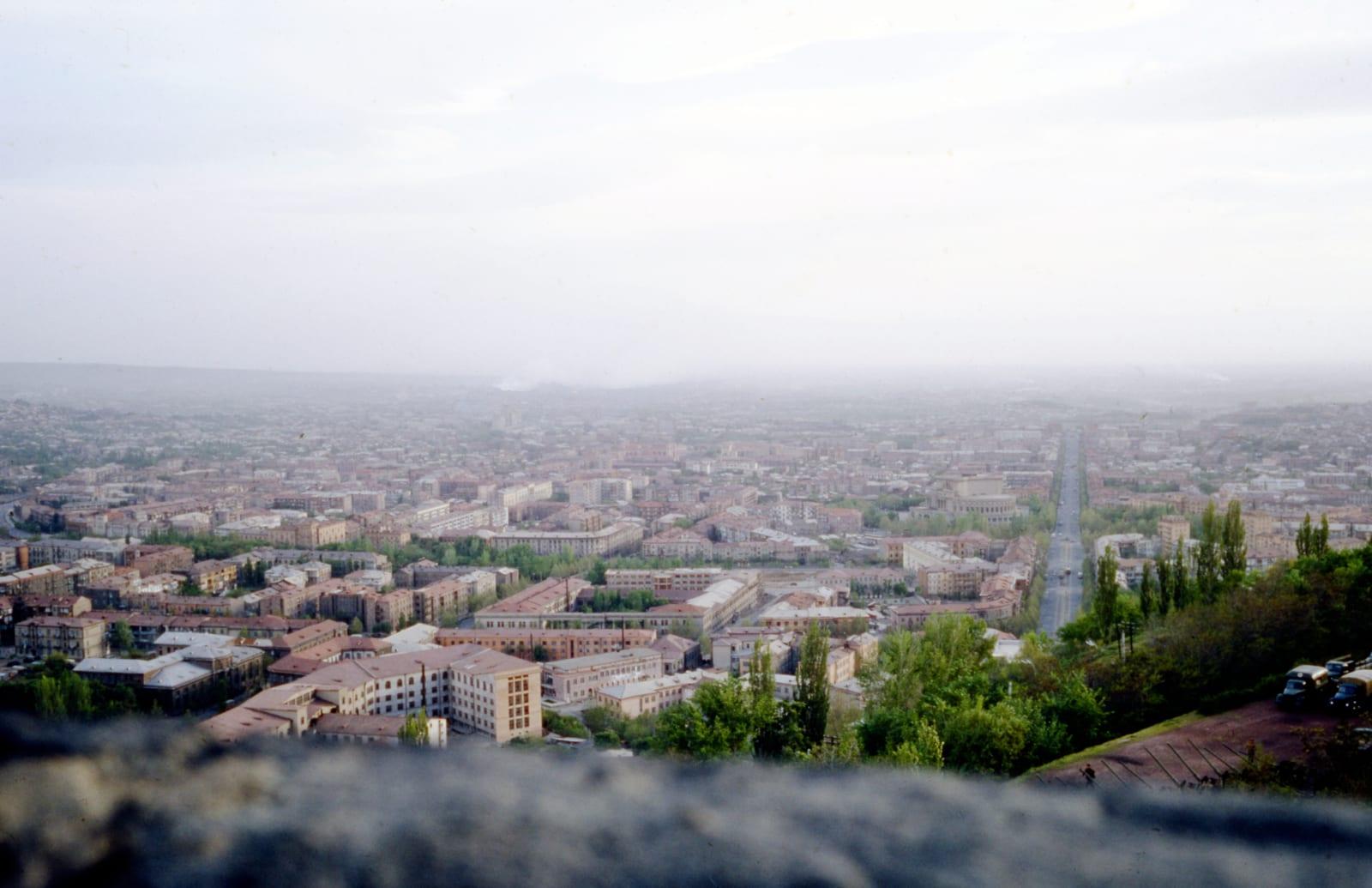
1964. Yerevan from the hill in Victory Park, a slide by Thomas Hammond. A strip of green runs along the avenue below the hill. The next frame was taken from the same park in 2017.
Photo: Thomas Taylor Hammond / University of Virginia CREEES · Wikimedia Commons · CC BY-SA 4.0
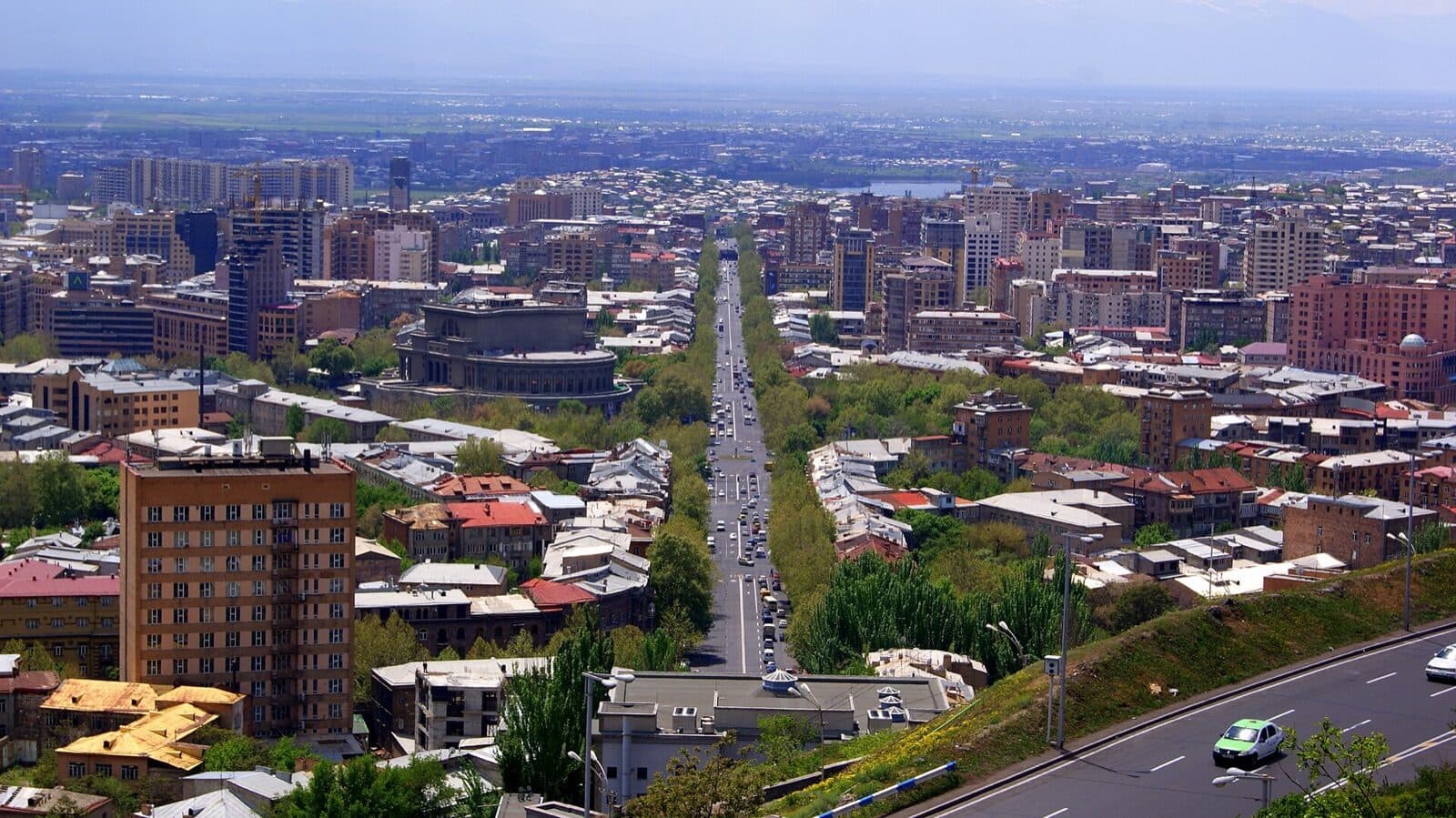
8 May 2017. Mashtots Avenue from Victory Park: rows of trees on both sides, the Opera on the left, and taller blocks around it than in 1964.
Photo: Armineaghayan · Wikimedia Commons · CC BY-SA 4.0
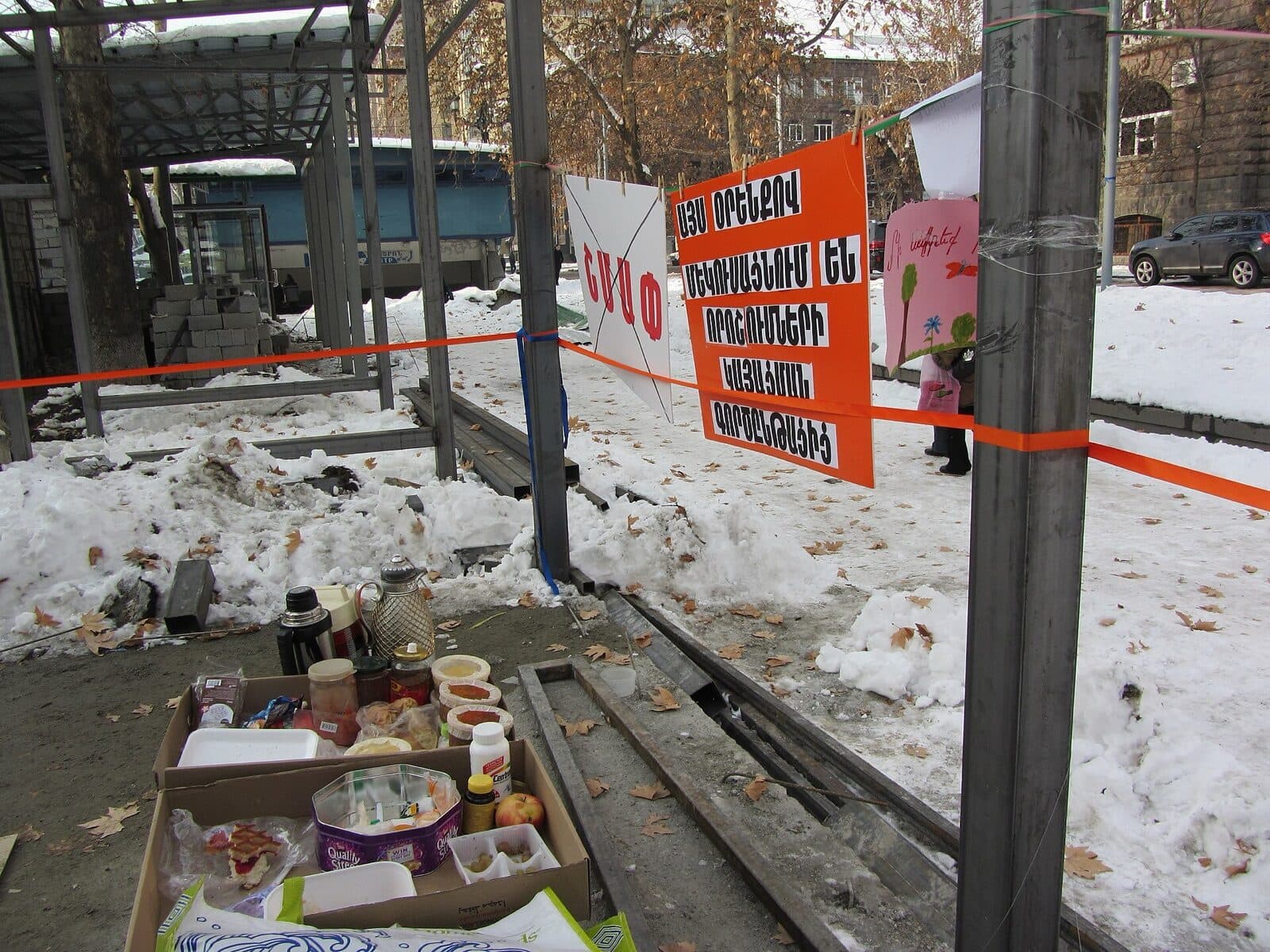
14 February 2012, the fourth day of the watch in Mashtots Park. Posters hang on tape between the steel frames of the pavilions under construction, with food and thermoses for the people keeping watch on a box.
Photo: Raffi Kojian · Wikimedia Commons · CC BY-SA 4.0
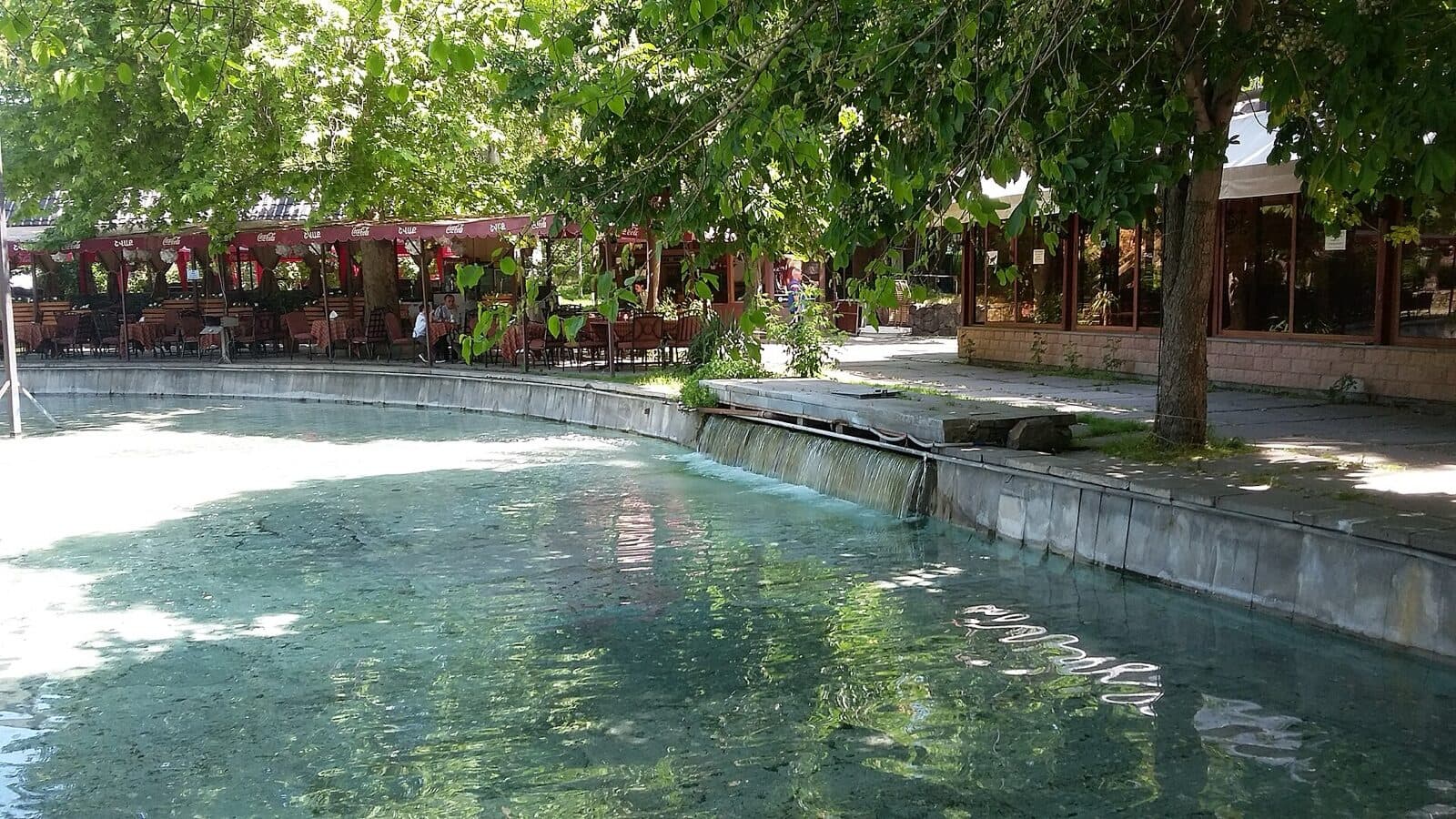
18 May 2019. Ring Park: a pond with café tables under the crowns behind it. A year later Hetq would count 98 commercial tenants on one section of the park.
Photo: 23artashes · Wikimedia Commons · CC BY-SA 4.0
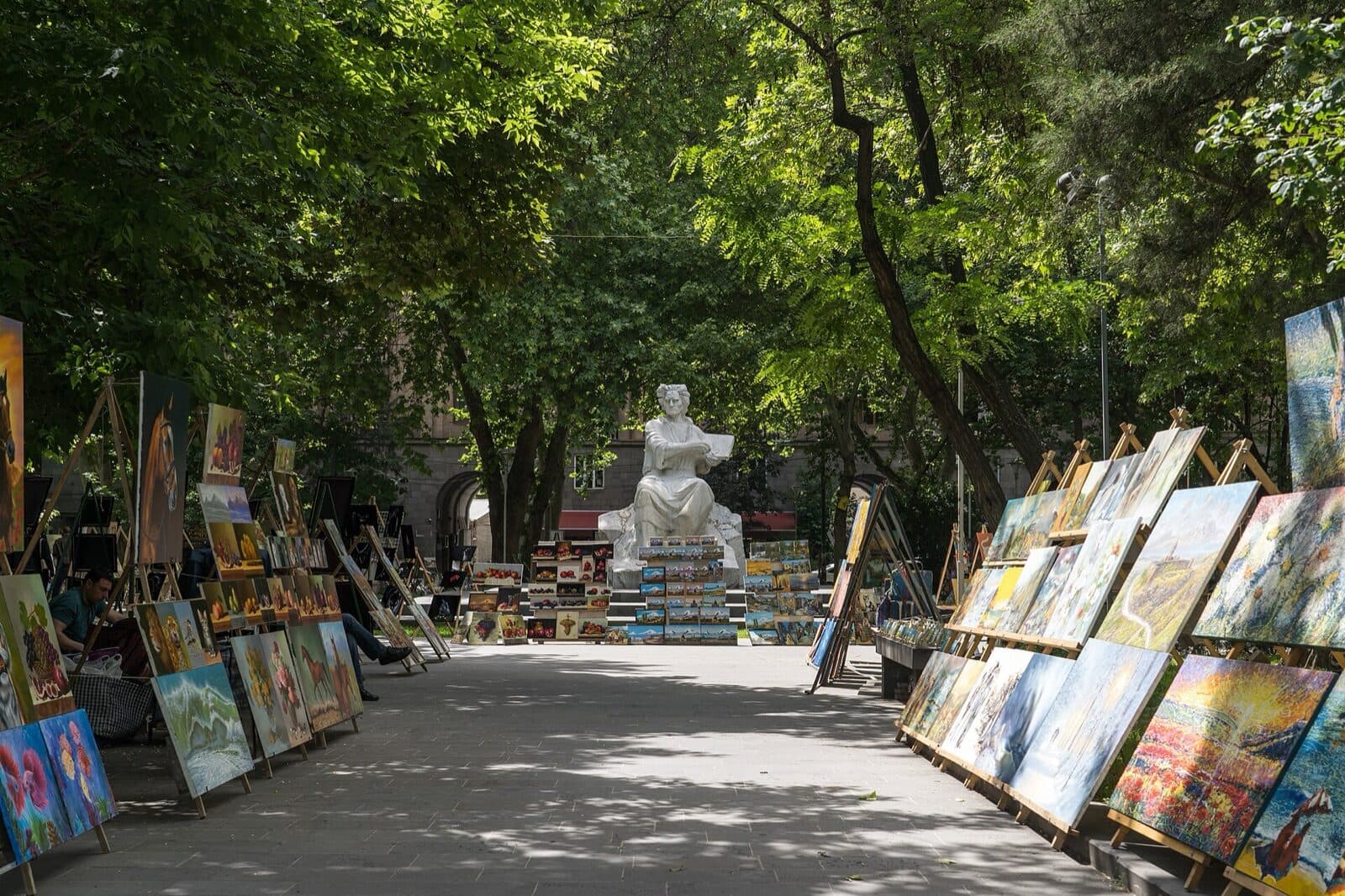
18 May 2025. Saryan Park: painters show their work in the shade of closed crowns.
Photo: Alexkom000 · Wikimedia Commons · CC BY 4.0
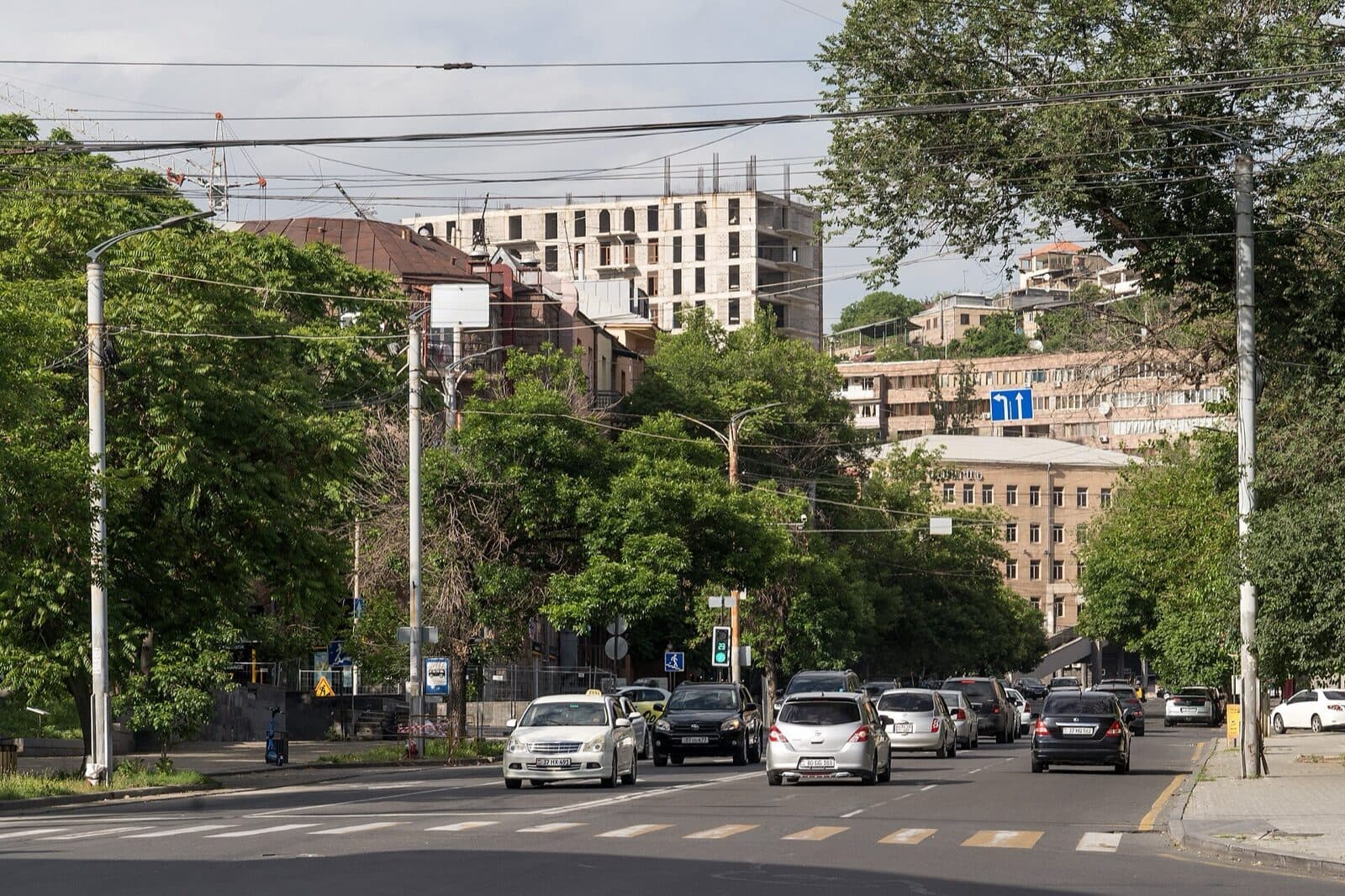
18 May 2025. Nalbandyan Street, one of the control streets on the satellite chart: trees on both sides, with a building under construction behind them.
Photo: Alexkom000 · Wikimedia Commons · CC BY 4.0
How much general-use greenery the city has
The Statistical Committee keeps no such series. Below are all the figures we found: the Soviet inventory as retold in a 2022 review, the new general plan's table and the old plan's target. The points are not joined by a line: the sources' definitions may differ.
In 2023 the general plan's table gives 906.8 ha, 38% of the target the old plan set for 2020.
General-use greenery, 1957-2023
Hectares. A figure with no day is placed in the middle of its year.
A hollow circle is a target, not a measurement.
Sources: Медицинская наука Армении, yerevan.am, EcoLur
yfp.am/en/topics/tree-cutting#green-area-chart
 Yerevan for People
Every figure and its source (12)
| Date | What it is | Hectares |
|---|---|---|
| January 1, 1957 | Soviet inventory At the start of 1957, by the 2022 review. | 625 |
| December 20, 1984 | Soviet inventory The Yergorzelenstroy trust's inventory, by the 2022 review. The review does not say what it included. | 1,817 |
| 2015 | 2024 general plan, Table 11.3.1 | 861 |
| 2016 | 2024 general plan, Table 11.3.1 | 863 |
| 2017 | 2024 general plan, Table 11.3.1 | 864.5 |
| 2018 | 2024 general plan, Table 11.3.1 | 867.3 |
| 2019 | 2024 general plan, Table 11.3.1 | 867.5 |
| 2020 | 2024 general plan, Table 11.3.1 | 871.3 |
| 2020 | Target of the 2005 general plan The 2005 general plan's target for 2020. | 2,382 |
| 2021 | 2024 general plan, Table 11.3.1 | 873.8 |
| 2022 | 2024 general plan, Table 11.3.1 | 887.7 |
| 2023 | 2024 general plan, Table 11.3.1 | 906.8 |
Greenery from orbit
Satellites see leaves by how they reflect light: they absorb red and reflect near infrared. The NDVI index is computed from those two bands: around zero for asphalt and roofs, above 0.6 for dense foliage. It does not count trees or tell them from a lawn, but a drop in NDVI at a place means there are fewer leaves there.
Streets where trees were felled, and six where they were not, 2016-2025
Sentinel-2 has imaged Yerevan since 2016, at 10 m a pixel. For each street we take the pixels within 20 m of its center line and their mean NDVI over July 1 – August 31. The gray line is the mean of six central streets the dossier records no felling on: Pushkin, Teryan, Nalbandyan, Aram, Hanrapetutyan and Abovyan.
Streets where trees were felled, and six where they were not, 2016-2025
Mean late-summer NDVI. A triangle at the bottom marks a felling.
Sources: USGS, Copernicus, OpenStreetMap
yfp.am/en/topics/tree-cutting#satellite-streets-chart
Yerevan for PeopleThe change over the summer after each felling, against the same change on the control streets:
| Place | Felled | Summers | At the place | On the controls (range) |
|---|---|---|---|---|
| Tumanyan | March 24, 2024 | 2023–2024 | -0.066 | +0.006 (-0.001 ... +0.012) |
| Tumanyan | March 24, 2025 | 2024–2025 | -0.040 | -0.002 (-0.011 ... +0.006) |
| Moskovyan | March 1, 2023 | 2022–2023 | -0.040 | -0.002 (-0.018 ... +0.021) |
| Square by City Hall | May 16, 2018 | 2017–2018 | -0.080 | +0.005 (+0.001 ... +0.011) |
| Melik-Adamyan | March 28, 2025 | 2024–2025 | -0.109 | -0.002 (-0.011 ... +0.006) |
Bagratunyats (March 2024) and Buzand (March 2025) are not on the chart: the sources do not say which stretch was felled, and the mean over the whole street shows no drop. The dip on Tumanyan in summer 2021 matches no felling we know of.
Share of green pixels in the city and around it, 1986-2025
The Landsat series starts in 1986, at 30 m a pixel. The boundary is the same for every year, today's, 226 km²; otherwise fields joined to the city would count as new greenery. A green pixel is one whose NDVI over July 15 – August 31 is at least 0.3. Four satellites are put on Landsat 8's scale from the years two of them imaged together. The surroundings are 142 km² of land more than a kilometer outside the boundary.
In 1986-1995 an average 40% of the city's pixels were green and 63% of the surroundings', in 2016-2025 28% and 47%. The city lost 12.1 points, the surroundings 15.5.
The surroundings are not untouched land either: the fields, orchards and villages of the Ararat valley. What both lines lose together is the weather, the irrigation and the building of the whole valley, and a 30 m pixel cannot tell a street felling apart from them. That shows only on the street chart.
Share of green pixels in the city and around it, 1986-2025
Percent of pixels with NDVI at or above the threshold.
Unchecked: only one satellite imaged that season, so there is nothing to compare it with.
Sources: USGS, Copernicus, OpenStreetMap
yfp.am/en/topics/tree-cutting#satellite-city-chart
Yerevan for PeopleEvery year (40)
| Year | Satellite | Scenes | City, % | Surroundings, % |
|---|---|---|---|---|
| 1986 | Landsat 5, unchecked | 3 | 43 | 64 |
| 1987 | Landsat 5, unchecked | 3 | 37 | 60 |
| 1988 | Landsat 5 | 3 | 50 | 73 |
| 1989 | Landsat 5 | 4 | 34 | 57 |
| 1990 | Landsat 5, unchecked | 1 | 31 | 63 |
| 1991 | Landsat 5, unchecked | 5 | 37 | 58 |
| 1992 | Landsat 5, unchecked | 2 | 43 | 67 |
| 1993 | Landsat 5, unchecked | 2 | 42 | 62 |
| 1994 | Landsat 5, unchecked | 2 | 44 | 63 |
| 1995 | Landsat 5, unchecked | 5 | 40 | 60 |
| 1996 | Landsat 5, unchecked | 3 | 34 | 56 |
| 1997 | Landsat 5, unchecked | 3 | 35 | 56 |
| 1998 | Landsat 5, unchecked | 6 | 36 | 54 |
| 1999 | Landsat 5 | 4 | 31 | 53 |
| 2000 | Landsat 5 | 6 | 27 | 48 |
| 2001 | Landsat 5 | 3 | 29 | 49 |
| 2002 | Landsat 5 | 3 | 36 | 54 |
| 2003 | Landsat 7, unchecked | 2 | 36 | 54 |
| 2004 | Landsat 5 | 4 | 33 | 52 |
| 2005 | Landsat 5 | 4 | 35 | 52 |
| 2006 | Landsat 5 | 2 | 32 | 52 |
| 2007 | Landsat 5 | 4 | 39 | 59 |
| 2008 | Landsat 5 | 5 | 27 | 50 |
| 2009 | Landsat 5 | 4 | 42 | 61 |
| 2010 | Landsat 5 | 4 | 36 | 55 |
| 2011 | Landsat 5 | 5 | 39 | 58 |
| 2012 | Landsat 7, unchecked | 2 | 21 | 48 |
| 2013 | Landsat 8 | 5 | 34 | 52 |
| 2014 | Landsat 8 | 6 | 28 | 47 |
| 2015 | Landsat 8 | 4 | 26 | 45 |
| 2016 | Landsat 8 | 4 | 30 | 49 |
| 2017 | Landsat 8 | 6 | 31 | 51 |
| 2018 | Landsat 8 | 6 | 29 | 48 |
| 2019 | Landsat 8 | 6 | 26 | 44 |
| 2020 | Landsat 8 | 6 | 31 | 49 |
| 2021 | Landsat 8 | 3 | 30 | 48 |
| 2022 | Landsat 8 | 4 | 22 | 43 |
| 2023 | Landsat 8 | 6 | 22 | 44 |
| 2024 | Landsat 8 | 5 | 31 | 50 |
| 2025 | Landsat 8 | 6 | 26 | 44 |
Landsat courtesy of the USGS. Contains modified Copernicus Sentinel data 2016-2025.
How much the city spends
Executed spending on line 2561, 'Environmental protection (not elsewhere classified)', from the annual budget execution reports, in 2025 prices by Armstat's consumer price index.
In 2025 prices that is 2,671 million dram in 2010 and 5,290 million in 2025; its share of all city spending was 3.5% and 3.8%.
The reports have no separate line for greening; it sits inside this one. In 2015, of the line's 2,190 million dram, 1,714 million went on establishing and maintaining green areas and 341 million on lawns and flowers; the rest on pest control, stray animals and public toilets. Waste collection is a different line.
Line 2561, 2010-2025, in 2025 prices
Million dram in 2025 prices.
Sources: Yerevan for People, Armstat
yfp.am/en/topics/tree-cutting#budget-line-chart
Yerevan for PeopleEvery year (16)
| Year | Million dram, that year's prices | Million dram, 2025 prices | Share of spending |
|---|---|---|---|
| 2010 | 1,660 | 2,671 | 3.5% |
| 2011 | 2,061 | 3,080 | 3.9% |
| 2012 | 1,985 | 2,891 | 3.4% |
| 2013 | 2,082 | 2,866 | 3.3% |
| 2014 | 2,129 | 2,845 | 3.1% |
| 2015 | 2,190 | 2,822 | 2.8% |
| 2016 | 2,134 | 2,790 | 2.7% |
| 2017 | 2,124 | 2,748 | 3.0% |
| 2018 | 1,965 | 2,480 | 3.1% |
| 2019 | 1,914 | 2,384 | 2.9% |
| 2020 | 3,417 | 4,204 | 5.3% |
| 2021 | 4,290 | 4,923 | 5.3% |
| 2022 | 4,563 | 4,821 | 4.8% |
| 2023 | 5,116 | 5,300 | 4.6% |
| 2024 | 6,042 | 6,240 | 5.3% |
| 2025 | 5,290 | 5,290 | 3.8% |
Promises & what happened
- Yerevan MunicipalityBroken
«Bring general-use greenery to 17 m² per resident by adding about 1,300 ha, to 2,382 ha by 2020.»
By the new general plan's table, there were 906.8 ha in 2023, or 8.3 m² per resident. The plan covers 2005-2020; EcoLur also calls it the 2006 plan. We have not checked from its text who adopted it or when.
- Hayk Marutyan — Mayor of Yerevan (2018-2021)Unverifiable
«Plant 500,000 trees in different parts of the capital; green the Nork forests and the areas by Saralanj Street with an irrigation system.»
This is the platform of the My Step alliance, whose list Hayk Marutyan headed. We found no total of plantings for 2018-2021. In May 2020 only irrigation work was under way in Saralanj; 6 ha and 1,650 trees and shrubs were planted there in 2022.
- Nikol Pashinyan — Prime Minister of ArmeniaBroken
«Plant 10 million trees in Armenia by 10 October 2020.»
The deadline was moved to the end of 2021. In January 2024 the environment minister said the project was unfinished. In Armavir province, by Hetq's account, about 90% of 23,500 saplings died. No source gives Yerevan's share.
- Yerevan MunicipalityBroken
«The Green City Action Plan: more than 8.5 m² of green per resident by 2022.»
The interim target was missed: the general plan gives 8.3 m² for 2023.
- Yerevan MunicipalityPending
«The Green City Action Plan: more than 10 m² of green per resident by 2030.»
Not yet due. The 2024 general plan sets the same 10 m² per resident, but with no date; the latest figure is 8.3 m² for 2023.
- Tigran Avinyan — Mayor of YerevanPending
«Establish a new forest park on 200 hectares of the Dalma Gardens.»
The area grew from statement to statement: 200, then 230, then 250 ha. In September 2025 the feasibility study was done and a concept developed with the Asian Development Bank was submitted to the Office for Implementation of Investment Programs. We found no planting.
- Yerevan MunicipalityPending
«The 2024-2028 development program: reach and exceed the minimum threshold of green per resident within the next 5 years.»
We have not read the program itself. EcoLur writes of 9 m² by WHO norms, Avinyan two weeks later spoke of 8 m². The general plan's latest figure is 8.3 m².
- Tigran Avinyan — Mayor of YerevanPending
«Establish 250-300 hectares of new green areas in Yerevan in the next five years.»
By City Hall's own reports, 13.5 ha were created in 2025 and 55-60 ha over three years; the three years begin before the promise. There is no independent count.
- Tigran Avinyan — Mayor of YerevanUnverifiable
«Stay off Melik-Adamyan Street for now and wait for the protesters' scientific opinion, on which to base a new review.»
On 8 April Avinyan said that without scientific proposals the program should continue; on 9 April Azatutyun still reported the pause. We found nothing on whether the protesters submitted an opinion, whether a new review was held, or whether Melik-Adamyan was felled.
- Greening and Environmental Protection (municipal non-commercial organization) — Yerevan City Hall's greening agency: inspects trees and proposes them for fellingPending
«More than 50,000 trees have a passport; the greening agency intends to open a public platform on them in the future.»
We found no public platform. City Hall does not say how many trees the city has in all, so the 50,000 has nothing to be compared with.
- Ministry of Environment of Armenia — Responsible for air protection policy and state monitoringPending
«The 2026-2030 national biodiversity plan: increase Yerevan's green space by at least 2 m² per resident.»
Claims & fact-check
- Armen Begoyan — Director of the Greening and Environmental Protection agencyDisputed
«The old plantings have lost their viability: they are diseased, cannot be treated and no longer do their job.»
In fact: Under the 2021 procedure every tree to be felled gets a ticket with photographs, but we found none published, and no independent assessment of the trees' condition. The program's opponents call the trees healthy; the claimant attached photographs to the suit but no instrumental survey of the trees. The court examined only whether an environmental review was needed, not the trees' condition.
Said: March 31, 2025 · Sputnik ArmeniaChecked: October 17, 2026 - Yerevan MunicipalityMostly true
«On Tumanyan Street 129 mature trees will be planted instead of 80 that lost their viability.»
In fact: The count adds up: 95 Judas trees are in, 34 more go into new tree wells, and 30 elms are kept on top of that. The release calls ten-year-old trees mature. CivilNet counted about 50 trees felled against City Hall's 80.
Said: March 24, 2025 · yerevan.amChecked: October 17, 2026 - Kristina Vardanyan — Member of the Yerevan Council of Elders, National Progress factionUnsubstantiated
«700 mature dense-crowned trees have already been felled.»
In fact: This is the figure of the claimant's witness, from the same faction, given without a count. Neither City Hall nor the claimant has published a street-by-street count; from City Hall's reply for 2023-2024 we can count only the trees planted, not those felled.
Said: August 29, 2025 · FacebookChecked: October 17, 2026
Litigation
- Administrative CourtFinalClaim rejectedCase no. ՎԴ/3596/05/24
Aram Torosyanv.Yerevan Municipality
To bar City Hall from felling trees without an environmental review.
Decided: November 13, 2025From 15 July to 6 August 2024 a court ban on felling applied across the city; the appeals court rejected Torosyan's appeal against lifting it on 30 September 2024. The court held that replacing the elms falls under sanitary felling and reshaping a green zone and needs no review. The judgment was not appealed: per the datalex.am registry it entered into force on 18 December 2025, and the case went to the archive in May 2026.
- Administrative CourtWithdrawnCase no. ՎԴ/3627/05/24
Aram Torosyanv.Yerevan Municipality
Torosyan's suit against City Hall over the felling on Tumanyan Street.
Decided: January 22, 2026The proceedings were closed after the claimant withdrew, by an application filed on 13 January 2026. He gave no reason in it, and the law does not require one; we found no public explanation.
Indicators
- Green space per capita
- 8.3m²/person
General-use greenery by the new general plan's table. A 2022 review, citing the Soviet inventory, gives 17.18 m² for 1984 but counts by its own method; the series are not joined.
Connections
- AmplifiesAir pollutionCrowns hold dust and give shade. In a Factor TV debate in February 2026, reported by EcoLur, tree cutting was named among the causes of Yerevan's heavy air.
- Related toMaster plan & city governanceThe general plan sets the green targets: the old one, for 2005-2020, promised 2,382 ha by 2020, the new one 10 m² per resident with no date.
What we don't know yet
- How many trees are felled a year. Felling tickets under the 2021 procedure are drawn up at City Hall; we found none published; for 2023 City Hall gives 1,128 dry and damaged trees, while EcoLur gives 136 damaged and felled. A request to the Environmental Protection Department would answer it.
- How many of the new trees took. City Hall gives 94% for the new green areas, Panorama.am wrote in 2024 of planes drying up on Sayat-Nova; there is no count for the replacement streets.
Sources
- The history and present problems of Yerevan's green infrastructureМедицинская наука Арменииarchive · October 20, 2023
- Evolution of the forest cover in ArmeniaInternational Forestry Reviewarchive · April 13, 2026
- Forest area (% of land area): ArmeniaWorld Bank / FAOarchive · July 4, 2025
- Cafe Boom 'Devastating For Yerevan Parks'Azatutyun (RFE/RL)archive · May 31, 2025
- New Café Adds To Yerevan Greenery ShrinkageAzatutyun (RFE/RL)archive · February 16, 2026
- More Yerevan Homeowners Face EvictionAzatutyun (RFE/RL)archive · February 16, 2026
- Mayor Defends Café Construction In Yerevan ParkAzatutyun (RFE/RL)archive · June 16, 2026
- Construction resumes in Mashtots ParkAzatutyun (RFE/RL), YouTubearchive · June 2, 2025
- Trees are being felled on Tumanyan StreetAysor.am, YouTubearchive · November 2, 2026
- Yerevan residents against City HallAliQRu, YouTubearchive · April 21, 2024
- On Tumanyan Street 129 Judas trees will replace 80 elmsKanachapatum, YouTubearchive · November 2, 2026
- 25.03.25 Rally against tree felling in YerevanEcoContext, YouTubearchive · June 6, 2025
- Redesign works under way on Melik-Adamyan StreetKanachapatum, YouTubearchive · November 2, 2026